 |
|||
 |
|||
|
|||


Filippo Brunelleschi
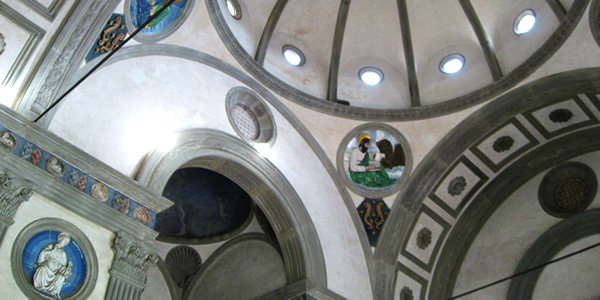
Brunelleschi's Pazzi Chapel at Santa Croce, Florence. (Photo by Gryffindor)
How a frustrated sculptor became the greatest architect of the Renaissance

Brunelleschi contemplates the cathedral dome that made him famous from a niche on the south side of Piazza del Duomo.
• Context: Monumental Genius, Brunelleschi and the Birth of the Renaissance
• Context: Duomo Complex
• Skip the Line: Florence Duomo with Brunelleschi's Dome Climb
ReidsItaly.com Florence Map
» View ENLARGED MAP with all listings
Filippo Brunelleschi (1377–1446) was a talented, hot-tempered, balding little man whose one dream in life was to be a great sculptor.
Yes, we know remember him as the greatest architect of the Florentine Renaissance, but first he spent years trying to make it in the sculpting game.
In fact, he once set up a little wager with his best buddy, Donatello, to decide who was the better carver.
Breaking some eggs in the Christ competition
Donatello had carved a small wood Crucifix for Santa Croce and asked Brunelleschi's opinion of it.
Now, Donatello was ahead of his time in incorporating naturalism and exacting verisimilitude in his art, and he had carved a very life-like Christ (as opposed to the stylized, Byzantine models that had come before).
However, when Brunelleschi saw it—perhaps expect something a bit more graceful (and known for being blunt)—he told Donatello it seemed he had "put on the cross the body of a peasant, not the body of Jesus Christ."
Donatello was usually a pretty easy-going guy, but these words from his friend and artistic confident must have stung, because he replied, "If it was as easy to make something as it is to criticize, my Christ would really look to you like Christ. So you get some wood and try to make one yourself."
Secretly, Brunelleschi did just that.
Several months went by, and the two were back to being best buds. One day, Brunelleschi asked Donatello to come over for dinner, and on their way to Brunelleschi's place they stopped for some eggs. Brunelleschi asked Donatello to gather these in his apron and go on to the studio ahead of him, as Brunelleschi still had a few more things to pick up.
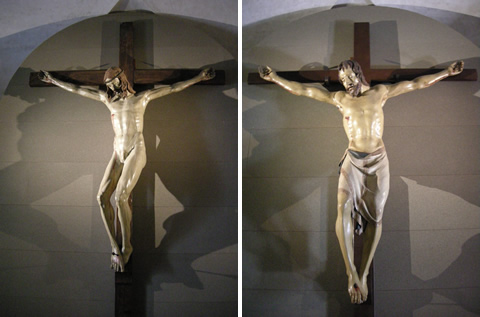
Crucifixions by Filippo Brunelleschi (left) and Donatello (right). (Photos by Sailko)When Donatello entered Brunelleschi's place, he saw Brunelleschi's Crucifix—placed so Donatello couldn't miss it upon entering. He was so astonished and overwhelmed by its beauty that he dropped his hands, and the eggs smashed the the floor. Brunelleschi found him this way, still admiring the work.
Brunelleschi asked Donatello what he thought, and he replied humbly, "Your job is making Christs, and mine is making peasants."
(Of course, to modern sensibilities, Donatello's "peasants" are far more interesting than the lithe and graceful but more ethereal likes of Brunelleschi's works. Suffice to say: they were both supremely talented. Donatello was simply more original.)
The day Brunelleschi gave up his dreams of being a sculptor
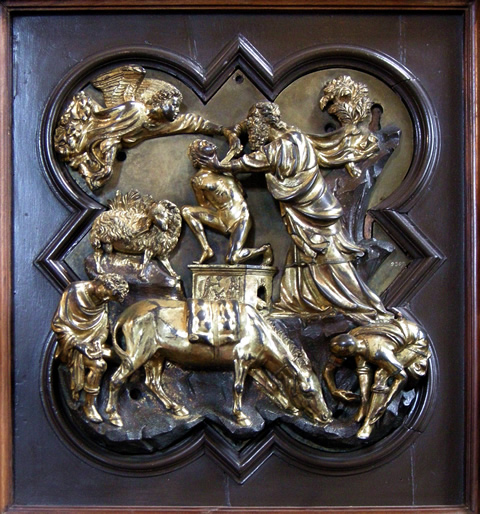

Two takes on the Sacrifice of Isaac for the 1401 Baptistery doors competition. Above, Brunelleschi's runner-up entry; below, Ghiberti's winning entry.Then came the famous 1401 competition to cast new doors for the Florence Baptistery, when Brunelleschi and Donatello (and many other noted sculptors of the day) all lost out to an upstart named Ghiberti.
The authorities offered Brunelleschi the task of collaborating with the unproven young sculptor to execute the commission, but the haughty Brunelleschi refused.
In typical hotheaded fashion, Brunelleschi resolved he would be second to no one, and gave up sculpture entirely.
Frustrated, Brunelleschi set his sights on mastering a different art. He invited Donatello to accompany him to Rome where they both could study ancient masters: Donatello those of sculpture, and Brunelleschi those of architecture.
Enter the architect
Not to spoil the ending, but upon his return to Florence, Brunelleschi's career as an architect succeeded beyond his wildest dreams (well, perhaps not his wildest dreams; the man was pretty arrogant and convinced of his own greatness to begin with).
He patented a style that we still call "Brunelleschian"—mathematically precise spaces of voluminous cubes and solid yet elegant curves, the walls layered in soft, off-white plaster, the architectural lines picked out in gray pietra serena stonework.
However, before he became the most popular designer of major churches in Florence, Brunelleschi had to prove himself. In the process, he ended up creating the very symbol of Florence itself.
The cathedral dome
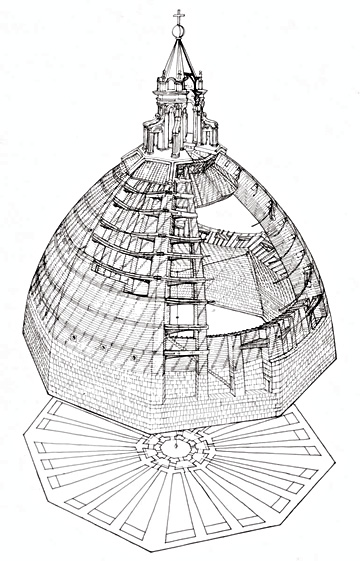
The ingenious construction of Brunelleschi's dome.By the early 15th century, Florence had nearly finished its ambitious, enormous new cathedral.
There was only one problem.
At its center was a yawning space, an architectural conundrum that had been kicked down the line of responsibility, each architect figuring the next one would have to figure it out.
See, the dome necessary to cover this space was far larger than any attempted since antiquity—and no architect of the time had any idea how to span the space.
No architect, that is, save Brunelleschi.
All the experts of the day said no one would ever be able to erect a dome that big—not without using scaffolding and supports that would be far too costly to build.
Among the suggestions to solve this part of the problem was to pile up a mound of dirt inside the cathedral, seeded with small coins. The dirt could be used as a support for building the dome, and then removed at no cost by inviting the poor to come take away pails of dirt in the hopes of finding some cash in it.
Scaffolding (or dirt pile) aside, even if it the workers had something to stand on while they labored, and even if the thing could be built, many were afraid a dome that large would simply collapse under its own weight.
Brunelleschi proved them all wrong
Eggs again
According to legend, Brunelleschi approached the church works authorities claiming he knew the answer and could build the required dome, but he refused to reveal his solution until granted to commission to do so.
The authorities were just as stubborn, and refused to grant such a major commission to a relatively untested architect. Besides, they had a long line of artists eager and willing to take on the task, may of whom had sketched plans or made models.
They were at a standstill. Then Brunelleschi issued his challenge. He produced and egg and a slab of marble. He said that if any of the other artists up for the job there could make the egg stand on its end on the smooth marble, he would tell them how he planned to build the dome. If they could not, and Brunelleschi could, he would receive the commission with no questions asked.
They passed around the egg, each trying carefully to balance it on its end, each failing.
Then it was Brunelleschi turn.
He took the egg in hand and brought it down firmly, end-first, onto the the slab. The end cracked and flattened, and the egg stood there, oozing albumin.
The gathered artists and dignitaries were indignant, claiming he was a cheat and that any of them could easily have done the same thing. To this, Brunelleschi replied, "And any one of you would have know how to vault the cupola, had you seen my model or plans."
Now there's every reason to believe this story is apocryphal (you may have heard the same tale told about Columbus), but it is the one Vasari tells, it fits nicely with Brunelleschi's character, and perhaps most importantly it neatly brings the broken egg theme back into the story.
(For the record: if true, Brunelleschi was playing a pretty big gamble here, because you can, actually, balance an egg on its end; all you need are steady hands—and the time of year has nothing to do with it, so forget that old tale about needing to do it on the equinox.)
Regardless of whatever theatrics may or may not have gone on, Brunelleschi eventually managed to secure the commission. And he did build the dome: 45m (148 feet) wide and 90m (295 feet) high from drum to the top of the lantern (rising to a total of 114.5m, or 375 feet, feet off the ground), with no pile of dirt or forests of scaffolding to support it, and—far from collapsing under its owen weight—the dome stands to this day, rising nobly above the city skyline as the symbol of Florence.
Here is how he did it.
The building of the dome
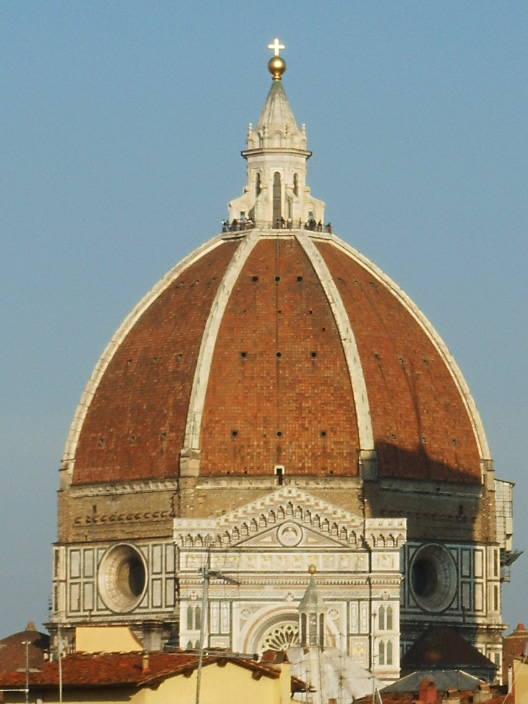
Brunelleschi's Dome on the cathedral of Florence. (Phot by Sailko)What Brunelleschi had actually done was to unlock the secrets of Rome's Pantheon. He used vertical marble ribs to distribute the weight, wrapping the inner wall with sandstone and chain "barrel hoops" between the ribs to prevent them from spreading.
He built the dome not as one piece but of two shells, an inner and an outer one, each thinning as they approached each other and the top).
He also had the brilliant idea to use interlocking bricks in a herringbone pattern. Bricks were lighter than stone, and interlocking them enabled the thing actually to support itself against its ribs as it was being built, removing the need for interior scaffolding at all—at least to support the structure's weight.
The workers still needed something to stand on while they laid all that brick, of course. So Brunelleschi simply incorporated hooks, holes, and rings into his design so that small, movable sections of scaffolding could actually be hung from completed sections of the dome, enabling his crew to work on the next section up (picture a window-washer's hanging platform).
Construction progressed from 1420 to 1436, during which time Brunelleschi developed several novel cranes and pulley systems to ferry materials up to the work area (some originals still on display in the Duomo Museum). He even installed a small taverna on site so workers wouldn't have to waste time climbing back down to the ground for lunch.
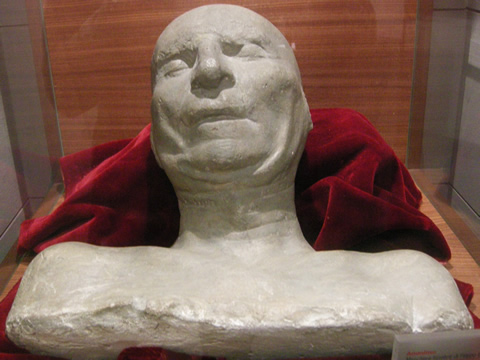
Brunelleschi's death mask. (Photo by Sailko) Brunelleschi didn't simply design an impressively large (and quite beautiful) dome. In the process, he also midwifed massive advances in engineering, created dozens of suddenly indispensable tools and machines, and revolutionized the Renaissance construction industry.
No bad for someone who had set out to be a sculptor.
For his efforts, Filippo Brunelleschi was according a singular honor. He remains the only Florentine ever buried in the cathedral itself—directly below his revolutionary dome.
Where to see works by Brunelleschi in Florence
- Cathedral dome
- Santo Spirito
- San Lorenzo
- Santa Croce (Pazzi Chapel)
- Museo dell'Opera del Duomo (exhibits on Dome construction; Brunelleschi's death mask)
Tours
- Take a tour: Take a guided tour that includes some of the top Brunelleschi sights in Florence:
- Context: Monumental Genius, Brunelleschi and the Birth of the Renaissance (Santo Spirito, Duomo, Ospedale degli Innocenti, Santi Apostoli)
- Context: Duomo Complex (Duomo, Museo dell'Opera del Duomo)
- Context: Santo Spirito Stroll (Santo Spirito)
- Skip the Line: Florence Duomo with Brunelleschi's Dome Climb (Duomo dome climb, Museo dell'Opera del Duomo)
Related pages
- Climbing Brunelleschi's dome in the Duomo
- More notable Florentines
- Guided art and architecture walks and museum visits
- More top 10 lists
- Florence itineraries - What to do if you have 1 day, 2 days, or 3 days in Florence
- Florence FAQ
- Florence homepage

Search ReidsItaly.com
This article was written by Reid Bramblett and was last updated in March 2013. All information was accurate at the time.
about | contact | faq
» THE REIDSITALY.COM DIFFERENCE «
Copyright © 2008–2013 by Reid Bramblett. Author: Reid Bramblett

- See
- Florence sightseeing
- Florence itineraries
- Top 10 lists
- Top 10 sights in Florence
- Top 10 experiences in Florence
- Top 10 masterpieces in Florence
- Top 10 museums in Florence
- Top 10 free things in Floence
- Top 10 churches in Florence
- Top 10 hotels in Florence
- Top 10 dining experiences in Florence
- Top 10 shopping opportunities in Florence
- Top 10 Florentines you need to know
- Reid's List: Florence
- Florence museums
- Florence churches
- Florence markets
- Florence tours, guides, & cooking courses
- Florence side-trips
- Reid's Florence blog
- Do
- Stay
- Eat
- Plan
 |
 |
 |
 |
 |
 |
 |
 |
 |
 |
 |
 |
Tours from Viator
