The ruins of Rome's ancient seaport are like Pompeii without the crowds—and just a 14-mile subway ride west of downtown.
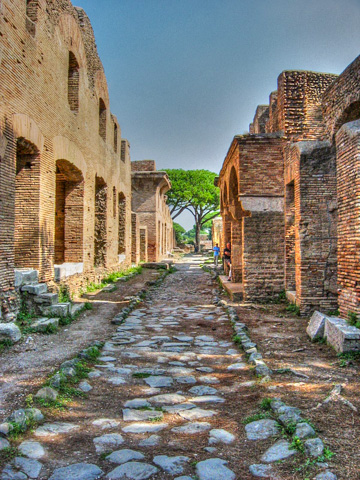
Abandoned when the empire fell—after which the gradual silting of the harbor moved the coastline out 4km and the ruins were plundered for their marble to build the cathedrals in Pisa, Florence, and Orvieto—this ancient ghost town has been only partly excavated, giving Ostia an aura of Romantic decay missing from most dusty, tourist-ridden archaeological sites.
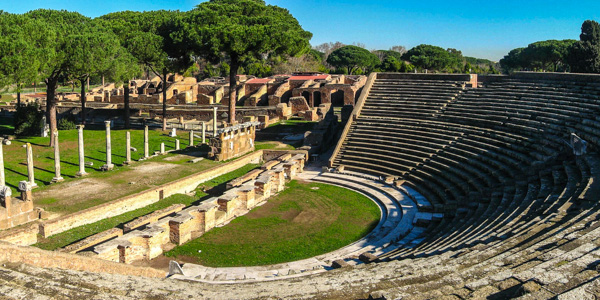
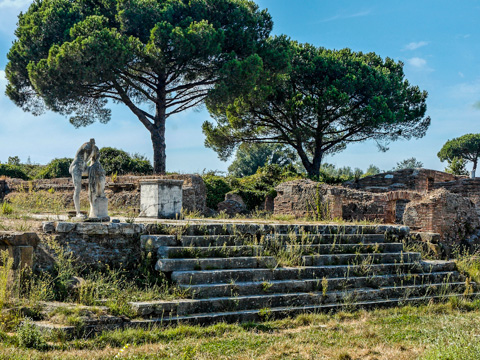
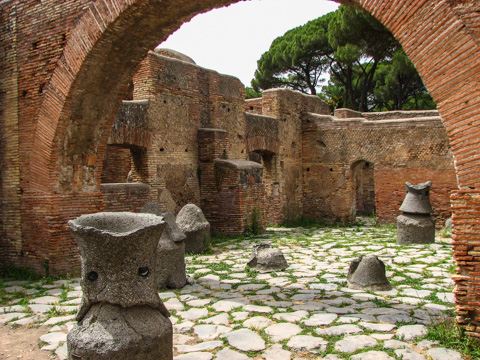
Scraps of fresco cling to the walls of private villas and columns guard roofless temples and their crumbling floor mosaics. Armless statues hide amid the tall grasses, millstones stand ready to grind in the back rooms of long-dead bakeries, and wildflowers speckle the stone seats of the ancient theater.
Though Ostia was founded in the 4th century BC, most of the building dates from between the AD 1st and 4th centuries, when the city reached its height of 60,000 inhabitants. The site plan they hand out at the gate is very good, and most of the structures inside the park are now placarded in English.
Most visitors follow the Decumanus Maximus (Latin for Main Street) from beginning to end, but take the time to explore the side streets where you'll find lots of intact shops, black and white floor mosaics, a few frescoes clinging to walls, and millstones hiding in the weeds behind baker's shops.
Make sure you stop at the well-preserved Theater, built in the AD 1st and 2nd centuries, which could seat 2,700 people. Several giant marble theater masks still survive on tufa columns at the stage.
The Casa di Diana is a typical three-story house with shops on the ground floor, some frescoes on the walls inside, and a courtyard fountain of the huntress goddess that gave the house its name.
On the town's Forum you'll find the Capitolum, an important temple with an imposing flight of steps and most of the brick cella still standing.
Finally, search out the Terme dei Sette Sapienti, a well-preserved baths complex named for the seven "sages" painted on the wall and spouting bath-house homilies. The central hall here retains its magnificent floor mosaic of hunting scenes.
Don't miss Ostia's on-site museum, which houses all the bits that unscrupulous types might try to carry off—as the Dark Ages barbarians and early baroque-era excavators did with wild abandon.
Upon advance reservation, on Sunday morning you can get a tour of the Case Decorate, restored Roman homes many with mosaics floors and frescoed walls intact.
Viale dei Romagnoli 717
Ostia Antica - Roma
tel. +39-06-390-8071 or 06-5635-8099
Ostiaantica.beniculturali.it
Also see:
Ostiantica.it
Ostia-antica.org
Tues–Sat as follows:
Last Sat in Mar–Aug 31: 8:30am–7:15pm
Sept: 8:30am–7pm
Oct 1–Last Sun in Oct: 8:30am–6:30pm
Last Sun in Oct–Feb 15: 8:30am–4:30pm
Feb 16–Mar 15 8:30am–5pm
Mar 16–Last Sat in Mar: 8:30am–5:30pm
Ostia Museum: Closes 1 hour before the site
Case Decorate: Sun at 10.30am by advance reservation only: tel. +39-06-5635-8044
€9 (€8 for adm + €1 pre-order)
Roma Pass: Yes (free, save 50%)
Metro: Porta San Paolo/Piramide (B) then the Ostia-Lido train to "Ostia-Scavi"
Planning your day: Get up early and make this a very full half-day.
Find a secluded spot under the umbrella pines for a BYO picnic. Then you can head back to Rome, or get back on the train (of hop bus C4, C13, C19, or 04) and continue one more stop to the end of the line—Ostia Lido, Rome's crowded (but clean) main beach.
Note: The ticket office (and on-site museum) close one hour before the site.
Take the B-line Metro to the Porta San Paolo/Piramide station, then switch to the train bound for the Lido (all one one regular Metro ticket); get off at the next-to-last stop, Ostia-Scavi (if you continue to the end of the line, Ostia-Lido, you end up at the beach).
The archaeological site is about a five-minute walk from the train staiton.
Take a guided tour of Ostia Antica with one of our partners:
Share this page
Search ReidsItaly.com
Viale dei Romagnoli 717
Ostia Antica - Roma
tel. +39-06-390-8071 or 06-5635-8099
Ostiaantica.beniculturali.it
Also see:
www.ostiantica.it
www.ostia-antica.org
Tues–Sat as follows:
Last Sat in Mar–Aug 31: 8:30am–7:15pm
Sept: 8:30am–7pm
Oct 1–Last Sun in Oct: 8:30am–6:30pm
Last Sun in Oct–Feb 15: 8:30am–4:30pm
Feb 16–Mar 15 8:30am–5pm
Mar 16–Last Sat in Mar: 8:30am–5:30pm
Ostia Museum: Closes 1 hour before the site
Case Decorate: Sun at 10.30am by advance reservation only: tel. +39-06-5635-8044
€9 (€8 for adm + €1 pre-order)
Roma Pass: Yes (free, save 50%)
Metro: Porta San Paolo/Piramide (B) then the Ostia-Lido train to "Ostia-Scavi"



This article was written by Reid Bramblett and was last updated in April 2015.
All information was accurate at the time.
about | contact | faq
» THE REIDSITALY.COM DIFFERENCE «
åß
Copyright © 2008–2017 by Reid Bramblett. Author: Reid Bramblett