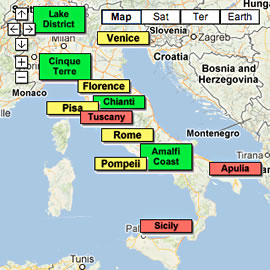
A travel guide to Apulia
Planning a trip to Apulia (Puglia), Italy
Why Apulia?
- Alberobello - The capital village of the Valle d'Itria, a fairytale land of cylindrical white houses with conical roofs.
- Lecce - The Florence of the baroque, a university town with fantastical architecture and a strong crafts tradition.
- Bari - The main city of Apulia has whitewashed streets and the tomb of Santa Claus himself.
- The Gargano Peninsula - The spur on the heel of Italy's boot is strung with sunny beaches, fishing villages, prehistoric artifacts, and the home of Italy's most popular modern saint.
- Ostuni - "The White City" is a whitewashed spiral of houses perched atop a hilltop near the sea.
- Brindisi - Plenty of interest to distract you as you wait for that ferry to Greece.
The heel of Italy's boot, peninsular Puglia (pool-yah) is the land of sunflowers and Santa Claus, olive oil and orecchiette pasta, Romanesque churches and whitewashed villages.
It's a cultural mélange unequaled in Italy, forming one of the country's most underrated, underexplored, and undiscovered regions.
Nowhere else in Italy is there a more precise balance of east and west, Greek and Roman, Byzantine and Lombard, Arab and Norman. Apulia wears its heritage on its sleeve—or rather in its streets, an intricate urban fabric woven from diverse architectural forms.
But don't expect to see the usual Italian versions of Gothic, Romanesque, or baroque. There must be something in the pristine waters and clear air of Le Puglie that inspires flights of fancy and bursts of genius in any craftsman, artist, or architect.
French, Spanish, and Italian, prehistoric, baroque, and postmodern—Apulia has taken in all influences and channeled them into some of Italy's most incredible syncretic styles.
These range from the prehistoric statue-steles of Manfredonia to Frederick II's weird octagonal Norman Castel del Monte near Bari, from the the whitewashed blind alleys of Saracenic street plans to the idiosyncratic baroque style of Lecce, and from towering Romanesque-Gothic cathedrals in the northern provinces to the curious, pointy trulli houses of Alberobello and the Itria Valley.
The craft industry thrives here, from the papier-mâché statuettes of Lecce fashion to the painted ceramics of Grottaglie.
Apulia is one of Italy's lushest breadbaskets, producing 54% of its olive oil, 19% of its grain, and an incredible 80% of Europe's pasta.
You'll discover dozens of hand-rolled pasta shapes, loaves of bread almost two feet across in Monte Sant'Angelo, delicious mussels in Taranto, and some incredibly full, earthy, but little-known red wines like Salice Salentino, Primitivo, and Locorotondo.
With 784km (470 miles) of grotto- and beach-studded coastline, whitewashed cities, incredible seafood, archaeological museums, glittering caverns, and medieval castles, Apulia is a unique landscape just waiting for the outside world to discover it.
Tips & links
Useful links & resources
Apulia tourism info: www.viaggiareinpuglia.it
Apulia tours & guides:
How long does Apulia take?
Planning your time: Frankly most of what most people see of Apualia is the ferry docks at Brindisi en route to Greece. But this is a region that rewards exploration. Take at least 2–3 days in Apulia. You could spend a whole week and be perfectly happy (and never run out of things to do or new places to see).
Do rent a car, though. You can get around by train and bus, but you can explore much better—and see more more quickly—with your own set of wheels.
Featured article
Once Upon a Time in Apulia. A feature on the Apulia (Le Puglie) region of Italy, from the cave culture of Matera to the trulli houses of Alberobello to the wild baroque architecture of Lecce. » more
Share this page

Search ReidsItaly.com