The Colosseum ★★★
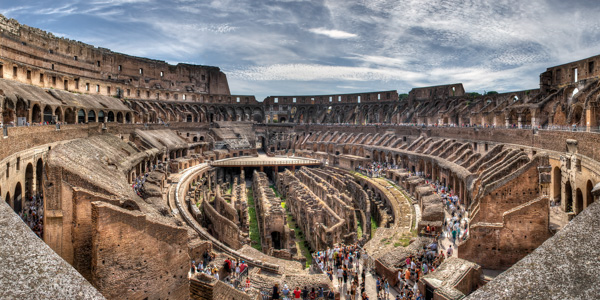
The interior of the Colosseum (Photo by Emilio Santacoloma)
Rome's Colosseo still ranks as the world's most famous sports arena, site of gladiator combat and the wholesale slaughter of wild beasts to amuse the public
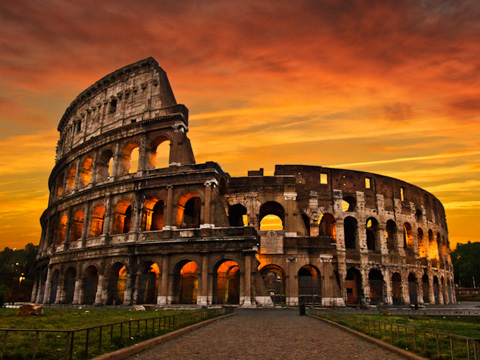
The Colosseum at sunrise. (Photo by Picmasta)
This wide majestic oval with the broken-tooth profile is the world's most famous sports arena.
Started in AD 70 on the filled-in site of one of Nero's artificial fish ponds (see the "Why is it called The Colosseum?" section below), this grand amphitheater was the "bread and circus" of the Roman Empire, an arena of blood and gore to amuse 50,000 of the masses at a time.
The inaugural contest in AD 80 lasted 100 days and killed off 5,000 beasts—these contests eventually drove to extinction several species, including the Middle Eastern lion and North African elephant—and countless gladiators.
Booking entrance tickets
Book your entry ticket to the Colosseum ahead of time and save yourself an hour in line. Bonus: the ticket also includes the Roman Forum and Palatine Hill: tel. +39-06-3996-7700, or on-line at www.coopculture.it or via our partners at Select Italy:
Visiting the Colosseum
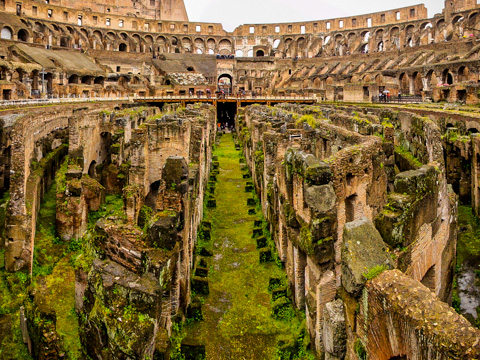
Now that the sand-covered wooden floor is gone, you can see the basement corridors—or 'dungeons'—of the Colosseum, where gladiators and wild beasts waited their turns in the area above—and you can even
take a special tour of them. (Photo by Matt Hintsa)
The most impressive aspect of the Colosseum is viewing it from afar, admiring that unmistakable silhouette, the symbol of Rome itself.
The interior is, frankly, a bit disappointing, although visits have improved dramatically with the recent reopening of the upper levels and the lower-level "dungeons"to visitors (thogh you can visit only in small groups and with a required guide).
"While the Colosseum stands, Rome shall stand; when the Colosseum falls, Rome shall fall; when Rome falls, the world shall fall."
—AD 7th century Anglo-Saxon pilgrims' proverb, quoted by the Venerable Bede
The Colosseum fell into disuse as the empire waned.
Earthquakes caused considerable damage, and later generations recycled its stone building blocks and marble cladding as a mine of precut building materials for their medieval buildings, Renaissance churches, and baroque palaces.
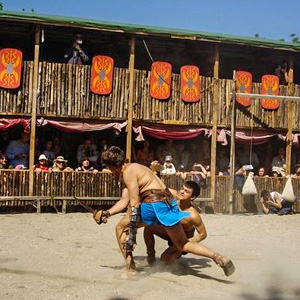
Cheesy? Yes. Fun? Undoubtedly. Besides, this is not just a chance to dress up in silly Imperial costumes and learn to wield a net and shield or spear and rudas (practice sword) or gladius (the short Roman sword from which gladiators got their name). It's also a hands-on history lesson—how better to learn a bit about daily life (and grisly death) in ancient Rome than being trained in the gladiatorial arts?...
» more
The seats are gone, as is the wooden floor—though one-fifth of it has recently been replaced so you can get an idea of how it once appeared.
The overall impression, though, is that of a series of nested broken eggshells of crumbling brick, littered with lazing cats and cupping a maze of walls in the center.
These walls mark the corridors and holding pens for the animals, equipment, and gladiators—an area until recently tantalizingly visible, yet closed to the public. Now, however, you can get down there to explore the gladiatorial warren, but if you book the special Coloseseum dungeons and upper tiers tour.
The Arch of Constantine
You'll notice as you're waiting in line (though you should book tickets ahead of time; see "Tips" below) a huge marble arch standing alone between the Colosseum and the back entrance to the Roman Forum.
This is the Arch of Constantine, one of the largest of Rome's ancient triumphal arches.
The life and death of a Roman gladiator
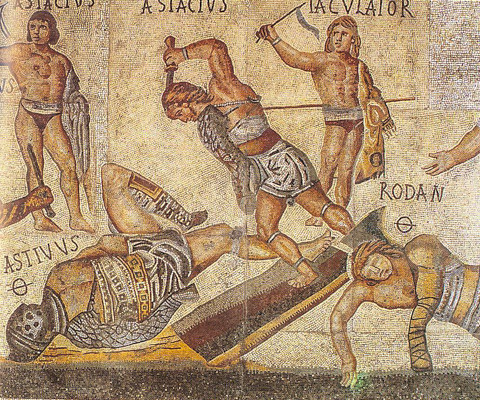
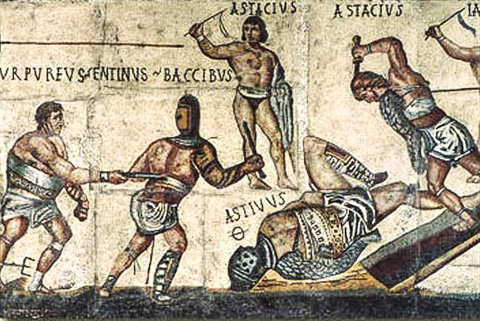
This 4th century mosaic, now in the
Galleria Borghese, was like having a poster of sports heros on your wall: Pictures of 33 famous gladiators, with the names of those who died in the arena labelled with a ϴ [Greek theta] next to them.
Russell Crowe aside, professional gladiators were young men (sometimes women) who, either poor or ruined, slaves or criminals, were lured by the promise of prize riches to sell themselves into a kind of slavery to the trainers and lead brutish, dangerous lives.
If a gladiator was seriously wounded but not mortally, he stretched out on the ground and raised his left arm for mercy.
The victor then usually decided his opponent's fate. However, when the emperor was around, he got to make the call, giving us a gesture we still use today.
Gauging the crowd's reaction, he judged whether to spare the loser by flashing the thumbs-up signal, or give the order to finish him off by gesturing thumbs down.
(Some spoilsports would have us believe the two gestures in ancient times were actually thumbs-down for death and thumbs-sideways for life; I try to ignore these people.)
The only release from gladiatorial life was death in the ring or the granting by the emperor of the rudis, a wooden sword that signaled a dignified, well-earned retirement from the games.
Incidentally, Christians were not thrown to the lions here—or at least an event was probably never billed as such.
It was true that oftentimes prisoners were tossed into the arena to fight to the death with wild animals, and since Christianity was outlawed at various times during the Empire, Christ worshippers were probably among those unfortunates on occasion. But it's unlikely many screamed for Christian blood by name.
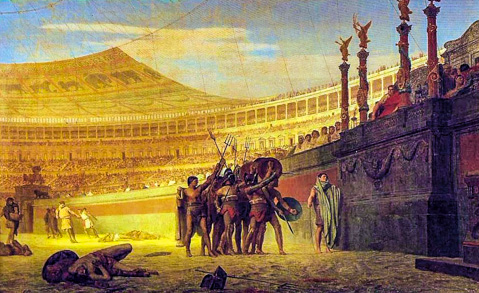
The gladiators salute the emperor in the classic "Ave Caesar Morituri te Salutant" moment in this slightly fanciful 1859 painting by Jean-Léon Gérôme.
One more possibly apochryphal tale: Only ancient history recorded any instance of the following practice.
According to Suetonius, on at least one occasion in AD 52 combatants did enter a place of battle, raise their arms to honor the emperor, and call out, "Ave Caesar! Morituri te salutant!"—famously translated as "Hail Caesar! We who are about to die salute you!"—to which Caeasr rather encouragingly replied "Aut non." ("Or not.")
However, this did not happen at the Colosseum but rather during a mock naval battle on Lake Fucinus, and the combatants were not professional gladiators but rather a motely crew of convicted criminals and captured soldiers. As such, it might have been a form of last-minute protest on the part of the condemned, mocking the entire proceedings and their ill-fated role in them with some good old 1st century sarcasm.
How to Build a Colosseum
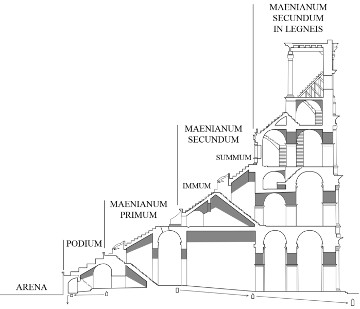
The seating plan of the Colosseum.
Architecturally, the Colosseum is a poster child for the classical orders of architecture: Three levels of 80 arcades each, set with niches once filled by statues and supported by columns that became more ornate with each level, following the Greek orders of Doric, Ionic, and Corinthian, respectively.
A fourth level—plainer in design, alternating small windows and large bronze plaques—supported a forest of some 240 wooden beams and their accompanying apparati of pulleys, beams, and canvas that togather created a retractable roof, winched out by a specially trained troupe of sailors to shade the seats from sun and rain. (Astrodome, eat your heart out.)
This massive stadium was nearly 49m (160 feet) high, with an inner arena measuring 76m by 44m (249 x 144 feet).
Fun fact: The very word "Arena" actually dervices from harina, the Latin term for the kind of very fine sand that was strewn over the Colosseum's wooden floor. it had one purpose: To soak up all the blood.
(This word for a super-fine granular substance lives on in several Romance languages. The Spanish word for "flour" is still "harina;" in Italian, it's close: farina.)
Why is it called The Colosseum?
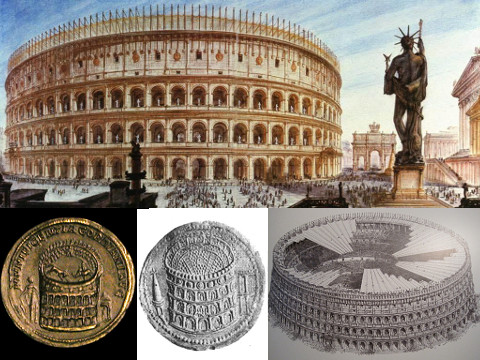
The Colosseum as it used to look:
Top: A modern, painted reconstruction showing the roof poles ringing the top and the Colossus of Nero to one side;
Lower left: On a medallion from the reign of Gordianius III (AD 238–244), clearly showing the Colossus of Nero;
Lower middle: A coin from the reign of Titus (ca. AD 80), with the Meta Sudans (a fountain destroyed by Mussolini in 1934) on the left; the Colossuem would have been behind that;
Lower right: A modern drawing depicting sailors unfurling sections of the Colosseum roof along its rigging.
The official name for this giant sports arena is the Anfiteatro Flavio, or Flavian Amphitheater, because it was started by the Emperor Vespasian in AD 70 and finished by his son Titus in AD 80, and their family name was Flavian.
The emperors never really got their due, though, because, even in antiquity, the stadium quickly earned the nickname "colosseum" (in Italian, colosseo).
See, before there was an arena here, there was a giant artificial fish pond built by Nero as part of his imperial pleasure gardens connected to the famed Domus Aurea, or Golden House.
Nero being Nero, his palatial complex (most of which lies buried under the hill just NNW of the Colosseum) included an enormous statue of himself as the god of the sun in gilded bronze.
At 35m (115 ft), this was the largest bronze statue ever constructed, and the idea was to outdo the famed Wonder of the Ancient World, the Colossus of Rhodes.
The statue was known as the Colossus of Nero, or simply "The Colossus," and when Hadrian moved the thing (it took 24 elephants) to stand beside the Flavian Amphitheater in the early 1st century AD, the nickname spread to the arena as well.
(Which, incidentally, is why it's properly spelled "Colosseum" and not "Coliseum.)"
The last remnants of the statue were destroyed in 1936, though you can still see its raised base, 7m (23 ft) to a side and planted with an ilex grove, at the end of Via dei Fori Imperiali between the road and the Colosseum.
Tips & links
Details
ADDRESS
Piazza del Colosseo
tel. +39-06-7740-0922 or +39-06-3996-7700
www.isromantique.it
or
www.coopculture.it
OPEN
Daily as follows:
- Last Sun in Mar–Aug 31: 8:30am–7:00pm
- Sept 1–30: 8:30am–7pm
- Oct 1–last Sat in Oct: 8:30am–6:30pm
- Last Sun in Oct–Feb 15: 8:30am–4:30pm
- Feb 16–Mar 15: 8:30am–5pm
- Mar 16–last Sat in Mar: 8:30am–5:30pm
Last entry: One hour before closing
ADMISSION
€12 (free first Sun of month)
Book tickets: Reserve tickets ahead of time with Select Italy:
Roma Pass: Yes (free, or 37% off)
Colosseum tours: From €32
TRANSPORT
Bus: 75, 81, 85, 87, 175, 271, 673, C3, 53, 186, 571, 810, 80 117, N2, N10
Metro: Colosseo (B)
Hop-on/hop-off: Colosseo
TOURS
How long does the Colosseum take?
Planning your day: Expect to spend about 60–90 minutes here (longer if you have to wait in line—though you can avoid that; see the next tip).
The ticket office closes (and last entry allowed) one hour before the site does.
» Rome itineraries
Book Colosseum tickets ahead of time
Lines at the Colosseum can last up to an hour in summer. To save your precious vacation time, it's well-worth paying the €1.50 fee to book your entry ahead of time (tel. +39-06-3996-7700, www.coopculture.it or at Select Italy)—though if you're visiting in off-season, the wait is usually more like 15 minutes so booking might not be necessary.
Colosseum and Forum entry
Colosseum dungeons and upper tiers (separate admission; comes with required guide)
Night tours at the Colosseum
If you don't book ahead and there's a long line right at the Colosseum, you can also buy tickets at three other places:
- At the main Forum entrance (on Via della Salaria Vecchia 5/6, on the east side of the Forum just off Via dei Fori Imperiali/Via del Foro Romano).
- At the base of the Palatine Hill at Via San Gregorio 30 (just south of the Colosseum along that wide, busy road),
- At Piazza Santa Maria Nova 53 (inside the south end of the Forum, 200m from the Colosseum)
Cumulative tickets & passes
The regular ticket covers entry to both the Roman Forum/Palatine Hill and the Colosseum for the amazing low price of €12 (you get two days in which to visit them both).
You can buy this ticket ahead of time (and skip the lines) via Select Italy. Or buy a ticket at any of four ticket offices:
- At the main Forum entrance (on Via della Salaria Vecchia 5/6, on the east side of the Forum just off Via dei Fori Imperiali/Via del Foro Romano).
- At Piazza Santa Maria Nova 53 (inside the south end of the Forum, 200m from the Colosseum)
- At the Colosseum.
- At the base of the Palatine Hill at Via San Gregorio 30 (just south of the Colosseum along that wide, busy road),
This is a fantastic deal—though also consider using this as one of the two freebies you get with the Roma Pass (you get two "get in free" coupons, and this is one of the pricier entries on the potential list, so a great choice to use a coupon on). » more
I advise against the Archeologia Card, which you will also see offered. This card covers entry to these sights (Forum & Colosseum) plus the Museo Nazionale Romano group (Palazzo Massimo alle Terme, Palazzo Altemps, Baths of Diocletian, Crypta Balbi, Aula Ottagona; normally €7–€10), and the Appian Way group (Baths of Caracalla, Tomb of Cecilia Metella, Villa of the Quintili; normally €6).
Sounds good, right? Some major-league sights in there, yes? True: But the savings is actually only €2–€5, and you can get more bang for your sightseeing buck by using the Roma Pass instead to cover the Forum/Colosseum (plus either the Museo Nazionale Romano group or something else major like the Galleria Borghese). » more
Colosseum tours
The Coloseum offers 45-minute tours in English (7 times a day) and Spanish (4 times a day) for €5.
Ot take a guided tour of the Colosseum with one of our partners:
Night tours of the Colosseum
The Colosseum is open for night tours Thursdays and Saturdays from May 2 to Nov 2.
Tours depart regularly from 8:20pm to 10:45pm, some in English, others in Italian. Note that the last tour of the night is often an extended tour that also includes a visit to the subterranean passages.
You can reserve the tour ahead of time through Select Italy.
Nearby...
SIGHTS
PLACES TO EAT
PLACES TO STAY
Rome tours
Walks & Day tours
Longer tours
Share this page

Search ReidsItaly.com