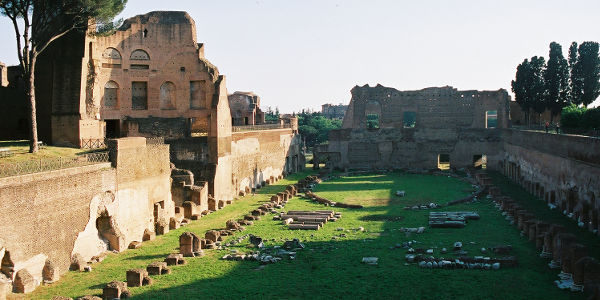
The Palatine Hill was where Rome began as a tiny Latin village (supposedly founded by Romulus) in the 8th century BC. Later it was covered with the palaces of patrician families and the early emperors.
Today it's an overgrown, tree-shaded hilltop of pretty gardens and fragments of ancient villas (only a handful of which are open to the public) that few visitors bother to climb.
(Most people actually enter it from within the Roman Forum—though it now has its own dedicated entrance south of the Colosseum on Via S. Gregorio—over the years it has sometimes been considered a separate site with a separate entrance fee—though, thankfully, not currently.)
The Palatine Hill—Palatium in Latin—was the poshest address in Ancient Rome, a veritable Beverly Hills where everyone from Cicero to Catullus to Marc Antony lived. Augustus Caesar was born here, and Emperors from Caligula and Nero to Domitian and Septimius Severus made it their home. Naturally, they built magnificent mansions, sprawling villas filled with architectural wonders and great art.
In ancient times, you didn't have to say someone lived in a posh pad; you merely had to say they lived in a palatium, and it was understood. Today, Italians pronounce the word palatium as "palazzo;" the French turned this into palais, and in English we pronounce it "palace."
As such, it can make for a romantic, scenic escape from the crowds, a place where you can wander across the grassy floors of ancient Imperial palaces and peer down the gated passageways that were once the homes of Rome's rich and famous (see sidebar).
In 1998, the Museo Palatino up here finally reopened after 13 years, displaying an excellent collection of Roman sculpture and finds from the ongoing digs in the Palatine palazzi.
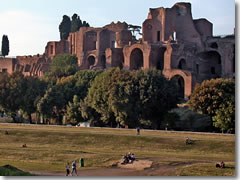
Many later palaces, built up on buttresses as they slowly expanded to extend beyond the crown of the hill, had a room that served as a sort of box seats section overlooking the Palatine's southern flank (see the picture below to the right).
This was so that Emperors and their guests could easily watch the chariot races and other games taking place at the Circus Maximus below, now a long grassy oval used mainly by joggers.
Entrances: Via di San Gregorio 30 (about 200m south of the Colosseum) or Piazza Santa Maria Nova 53 (inside the Roman Forum, up the Via Sacra across from the Colosseum)
tel. +39-06-699-841 or +39-06-3996-7700
www.isromantique.it
or
www.coopculture.it
Daily as follows:
Last entry: One hour before closing
€12
Book tickets: Reserve tickets ahead of time with Select Italy:
Roma Pass: Yes (free, or 37% off)
Bus: 75, 117, 53, 80, 85, 87, 175, 186, 271, 571, 810, N2
Metro: Colosseo (B)
Hop-on/hop-off: Piazza Venezia or Colosseo
Planning your day: You could wander around this hot and dusty hilltop in 30–45 minutes. To explore it more fully takes 60–90 minutes—perhaps longer, if you can talk your way into a palazzo (see below).
The ticket office closes one hour before the site.
Cumulative ticket: Your ticket is good for two days and covers admission to the Colosseum, Roman Forum, and Palatine Hill (though you can enter each site only once). You can buy this ticket ahead of time (and skip the long lines) via Select Italy.
Or buy a ticket at any of four ticket offices:
You can rent an audio guide from the entrance for €6 that gives you context and background details and walks you through the entire Forum and Palatine Hill site in about 70 minutes (don't bother with the €4 one just to the Palatine).
In summer, they sometimes run guided tours in English at noon for €5; call to see if they're still running.
Or sign up for a guided tour of Palatine Hill with one of our partners:
if you ask the museum's custodian, he may take you to one of the nearby locked palazzi and let you in for a peek at surviving frescoes and stuccoes.
Pack a picnic lunch to enjoy in the pockets of greenery that survive between the excavated remains of the ancient Roman palaces.
Though picnicking here is, I believe, technically against the rules, it nonetheless remains a lovely spot to enjoy your wine, bread, and cheese—just be discreet.
Share this page
Search ReidsItaly.com
Entrances: Via di San Gregorio 30 (about 200m south of the Colosseum) or Piazza Santa Maria Nova 53 (inside the Roman Forum, up the Via Sacra across from the Colosseum)
tel. +39-06-699-841 or +39-06-3996-7700
archeoroma.beniculturali.it
or
www.coopculture.it
Daily as follows:
Last entry: one hour before closing
€12
Book tickets: Reserve tickets ahead of time with Select Italy:
Roma Pass: Yes (free, or 37% off)
Bus: 75, 117, 53, 80, 85, 87, 175, 186, 271, 571, 810, N2
Metro: Colosseo (B)
Hop-on/hop-off: Piazza Venezia or Colosseo



This article was written by Reid Bramblett and was last updated in March 2014.
All information was accurate at the time.
about | contact | faq
» THE REIDSITALY.COM DIFFERENCE «
åß
Copyright © 2008–2017 by Reid Bramblett. Author: Reid Bramblett