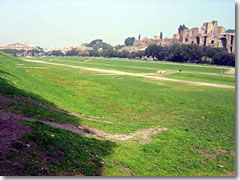
At 2,000 feet in length, it was the largest stadium in all of Rome, where the empire threw its most extravagant chariot races to entertain crowds of up to 300,000 screaming spectators.
The Rape of the Sabines
Rome was perilously short of women, and its founder, Romulus, needed a plan or his brand-new village was going to die out within a generation.
Romulus was not particularly known for his kindness—raised by a wolf, he supposedly slew his twin brother, Remus, in order to take sole control of the community they had founded together.
The population plan he hatched was pure Romulus. First he invited the neighboring tribe of Sabines to a big feast and party in their honor. Then, once the Romans got the Sabines good and drunk, they slew the men and carried off the wives and daughters to kick-start an enforced population boom.
This infamous episode became known as the Rape of the Sabine Women.The origins of the Circus Maximus are murky. Archaeological evidence shows that it was begun at least by the 4th century BC, but Livy said it was built by the Etruscan king of Rome Tarquin the Elder in the 7th century BC.
Roman tradition holds that it is older still, dating to the 8th century BC, and that it hosted its first races during the infamous feast thrown by Rome's first, legendary king Romulus (see sidebar).
Any story you pick, this is truly one of the most ancient sites in Rome.
In addition to the chariot races made famous in the sword-and-sandal epics of Hollywood's golden age, the circus maximus hosted horse races and other athletic competitions, death duels between wild beasts, even mock sea battles.
Julius Caesar famously held a mock battle here featuring a 1,000 infantrymen, 600 mounted centurions, and 40 elephants.
The spina down the center of the track was 1,100 feet long and marked by seven eggs (and, later, dolphins) to help spectators count off distance. To win a race, a charioteer in his quadriga (cart pulled by four horses) had to circle the spina seven times counter-clockwise—and come in first, of course.
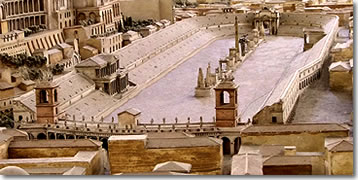
A model of the Circus Maximus in its heyday.Over the years, the spina also acquired as decoration two ancient Egyptian obelisks, which have since been moved.
(The obelisk of Ramses II is now in Piazza del Popolo; the obelisk of Tuthmosis III in now at San Giovanni in Laterano.)
The circus was continually enlarged and rebuilt throughout the Republican and Imperial eras until the dying days of the empire and rule of Totila the Goth.
The last chariot races were held in AD 549.
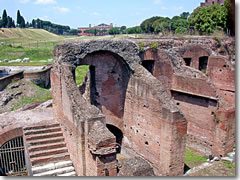
If you look north to the flanks of the Palatine Hill rising above the circus, you can see the buttresses of the vast palaces that once rose atop the hill.
These also served as box seats so the imperial family and other noted patricians could enjoy the spectacle far above the heat and dust—and, of course, crowds of commoners—below.
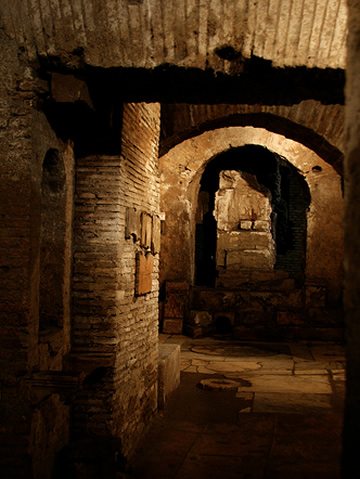 By special appointment or tour you can get into the Mitreo dell'Ara Massima di Ercole, the underground Mithraeum or Temple to Mithras, discovered during construction of a Fascist-era building.
While you're down here, you get to see some other underground remains of Roman temples. Cool.
Via dei Cerchi/Via del Circo Massimo
No phone
www.sovraintendenzaroma.it
Open daily (though I wouldnt hang around after dark)
Free
Bus: 81, 87, 122, 628, C3, 175, 715, 160F
Metro: Circo Massimo (B)
Hop-on/hop-off: Circo Massimo
Mithraeum (Open by pre-booked tour only, daily 9am–9pm):
Circus Maximus itself:
Planning your day: You can just overlook this from the Palatine Hill and be done. To wander the bits of brick vaulting on your way to the Aventine Hill takes maybe 15–20 minutes. » Rome itineraries
Take a guided tour of the Circus Maximus with one of our partners:
Mithraeum (Open by pre-booked tour only, daily 9am–9pm):
Circus Maximus itself:
Though perfectly salubrious by day, this is probably not a place to wander after dark. Nothing too dire; it's just a hangout for teenage gangs. Of course, it's also the site for major concerts and rallies, so you might be coming here after dark in purpose. Just be careful.
Share this page
Search ReidsItaly.com
Via dei Cerchi/Via del Circo Massimo
No phone
www.sovraintendenzaroma.it
Open daily (though I wouldnt hang around after dark)
Free
Bus: 81, 87, 122, 628, C3, 175, 715, 160F
Metro: Circo Massimo(B)
Hop-on/hop-off: Circo Massimo
Mithraeum (Open by pre-booked tour only, daily 9am–9pm):
Circus Maximus itself:



This article was written by Reid Bramblett and was last updated in February 2014.
All information was accurate at the time.
about | contact | faq
» THE REIDSITALY.COM DIFFERENCE «
åß
Copyright © 2008–2017 by Reid Bramblett. Author: Reid Bramblett