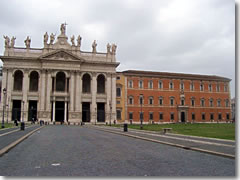
Yes, this is where the Pope holds down his day job as bishop of Rome. (Being the pontifex maximus, or head pontiff, of the entire church and sovereign head of state for the theocracy known as the Vatican is merely a perk for the priest who holds the Rome bishopric.)
The cathedral of Rome is, oddly, one of the least interesting of the city's grand churches. San Giovanni in Laterano has an illustrious history—founded by Constantine himself as the first Christian basilica in Rome in AD 313, and the model for all Christian basilicas.
However, after going through some seven cycles of destruction and rebuilding (due to fires, earthquakes, barbarians, or simple wholesale remodeling), today's basilica is primarily a Borromini construction of the 1640s—and even parts of that were destroyed and had to be restored following a 1993 bombing.
The massive facade by Alessandro Galilei is made of stacked porticoes with a line of colossal saints, apostles, and Christ standing along the top.
The gargantuan interior (230 feet long) has a unified decorative scheme designed by the noted baroque architect Borromini and a fine medieval Cosmatesque floor of marble and stone chips inlaid in geometric patterns.
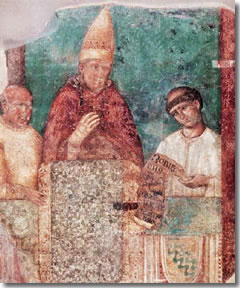
On the aisle side of the first pillar on the right is a fresco by the proto-Renaissance genius Giotto—all that survives of a series of frescoes the master painted here in the early 14th century.
The scene shows Pope Boniface VIII proclaiming the first Jubilee Holy Year on this very spot in 1300. This is significant not only because Giotto was a contemporary of the pope's, but also because that event pretty much kick-started modern tourism to Rome (pilgrims came first; sightseers followed), leading to a boom in taverns, inns, and souvenir stalls that really hasn't abated ever since.
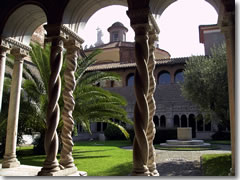
Across the street from the cathedral and to the left a bit is a small chapel-like structure housing the Scala Santa, the legendary staircase Jesus descended after being condemned by Pontius Pilate. » more
Piazza di S. Giovanni in Laterano
tel. +39-06-6988-6433
www.vatican.va
Church: daily 7am–6:30pm
Cloisters: daily 9am–6pm
Church: Free
Cloister: Free
Planning your day: You can wander the cathedral in a quick 20–30 minutes, but it is kind of out in the sticks—at the southern edge of the city center, by the San Giovanni Metro stop—so add another 15 minutes each way to get here and back. Add another 15–20 minutes to see the nearby Scala Santa. » Rome itineraries
Take a guided tour of San Giovanni with one of our partners:
You can attend services at St. John Lateran Monday to Saturday hourly from 7am to noon, plus 7:20am and 5pm (6pm July-Aug); Sundays hourly 7am–noon and at 6pm (plus at 5pm except in July and August, and Saturdays at 4:30pm except in August)
Share this page
Search ReidsItaly.com
Piazza di S. Giovanni in Laterano
tel. +39-06-6988-6433
www.vatican.va
Church: daily 7am–6:30pm
Cloisters: daily 9am–6pm
Church: Free
Cloister: Free
Bus: 16, 81, 85, 87, 571, 650, 665, 673, 56, 186, 218, 360, 590, 810, N1
Metro: S. Giovanni (B)
Hop-on/hop-off: Colosseo



This article was written by Reid Bramblett and was last updated in March 2014.
All information was accurate at the time.
about | contact | faq
» THE REIDSITALY.COM DIFFERENCE «
åß
Copyright © 2008–2017 by Reid Bramblett. Author: Reid Bramblett