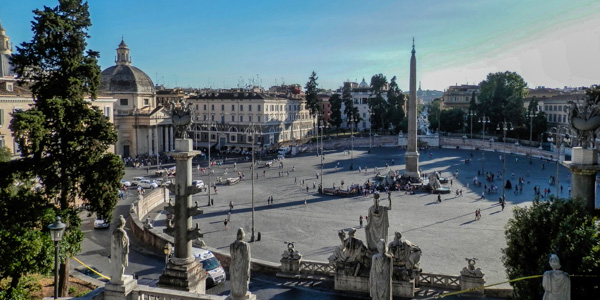
This huge oval space, filling a basin between the banks of the Tiber River and the terraced 19th century Pincio Gardens leading up to Villa Borghese Park, once formed part of the gardens belonging to Nero's family—and is said to hide the site where they secretly buried the crazed and despised emperor after he committed suicide.
Snuggled into the north end of the piazza is the amazing church of Santa Maria del Popolo, crammed with art and architectural works by Caravaggio, Bernini, Raphael, and Pinturicchio yet long overlooked by most Rome visitors (it's finally getting a trickle of tourists thanks to—of all things—a starring role in Dan Brown's Angels & Demons).
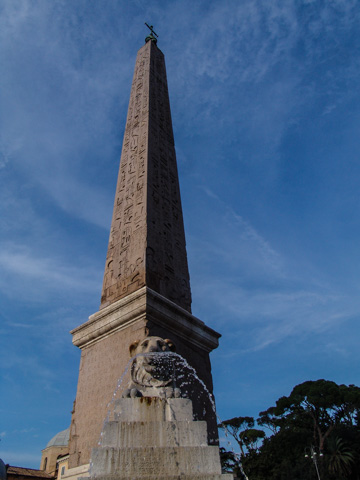
Piazza del Popolo—laid out, in its current state, by Giuseppe Valadier in 1811–22—is pinned at the center by the ancient Egyptian obelisk of Ramses II, now surrounded by a quartet of lions sending sheets of water splashing into basins at their paws.
This obelisk—removed by the ancient Romans from Heliopolis (now a northeastern suburb of Cairo)—was originally placed by Emperor Constantine at the Circus Maximus, then dragged up and installed here in 1589 by order of Pope Sixtus V.
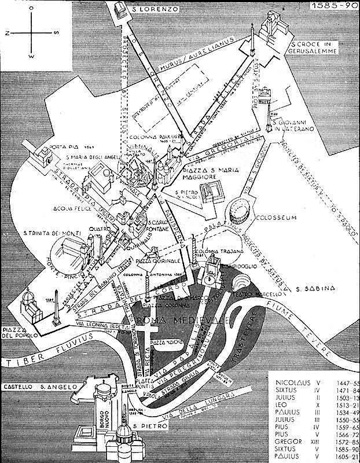
This was all a part of Sixtus V's grand civil engineering project to link together what were considered at the time the seven major churches of Rome—and remake Rome from a medieval town into the largely Renaissance and baroque city we know today.
Using archirect Domenico Fontana, he created new squares across Rome, each anchored (usually) by an ancient obelisk like this one, and then linked them all in with a web of new major streets—almost always having three major roads branching from each square to symbolize the Trinity.
In the process, he created the first modern city of Europe.
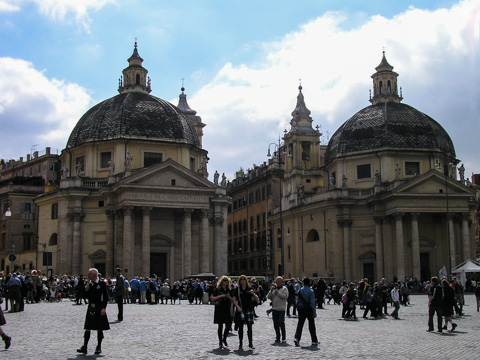
Piazza del Popolo is the classic and easiest-to-see example of this model of urban planning.
Off the south side of the piazza, between the two tiny "twin" churches of Santa Maria in Montesanto (on the left; built 1679) and Santa Maria dei Miracoli (on the right; built 1681)—which are not actually identical at all if you look closely (and, incidentally, are dull inside)—sprouts the trio of boulevards that make up the Tridente neighborhood: Via del Corso (Rome's "Main St."), Via del Babuino (leading to the Spanish Steps), and Via della Ripetta (leading to the Ara Pacis and Augustus' Mausoleum).
Piazza del Popolo (at the north end of the hsitoric center)
Daily
Free
Bus: 117, 119, 61, 89, 120F, 150F, 160, 160F, 490, 491, 495, 590, M; 81, 224, 628, 926, C3, N25
Metro: Flaminio (A)
Hop-on/hop-off: Piazza di Spagna
Planning your day: It is just a square, one you visit whiel passing through, but it is a lovely one, and worth spending 10 minutes or so admiring the obelisk and its lion fountains.
Take a guided tour of Piazza del Popolo with one of our partners:
Share this page
Search ReidsItaly.com
Piazza del Popolo (at the north end of the hsitoric center)
Daily
Free
Bus: 117, 119, 61, 89, 120F, 150F, 160, 160F, 490, 491, 495, 590, M; 81, 224, 628, 926, C3, N25
Metro: Flaminio (A)
Hop-on/hop-off: Piazza di Spagna



This article was written by Reid Bramblett and was last updated in March 2014.
All information was accurate at the time.
about | contact | faq
» THE REIDSITALY.COM DIFFERENCE «
åß
Copyright © 2008–2017 by Reid Bramblett. Author: Reid Bramblett