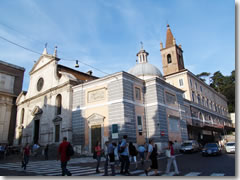
In 1099, church officials exorcised the specter by razing the trees and building on the site a church dedicated to "St. Mary of the People" (presumably those self-same superstitious people who clamored for its construction). The church was rebuilt in the 15th century.
Though virtually ignored by the Rome's teeming crowds of tourists, it's perhaps my favorite out of all the city's nearly one thousand churches. This little gem acts as a primer of Italy's Renaissance and early baroque movements, with examples in all the artistic disciplines—painting, architecture, fresco, sculpture, mosaics, and stained-glass—from various eras and by the very top names in the Old Masters game.
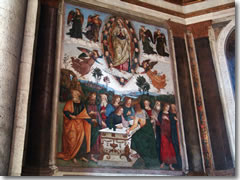
Representing the EARLY RENAISSANCE, we have Pinturicchio's 15th century frescoes of the Adoration of the Child and Life of St. Jerome in the first chapel on the right.
Architecturally, there Bramante's design for the shell-motif apse (nip through the curtain to the left of the high altar; they don't mind; switch on the lights in the fuse box on the left wall) set with Rome's first stained glass windows, commissioned in 1509 from undisputed French heavyweight master of that art Guillaume de Marcillat.
The apse is also and flanked by a magnificent pair of Early Renaissance tombs carved by Sansovino.
Forget Angels & Demons
I don't want to get into an argument about it. Let's just say this: entertaining though his adventures may be, pretty much everything Dan Brown wrote about this church was—from a factual and historical point of view—wrong.
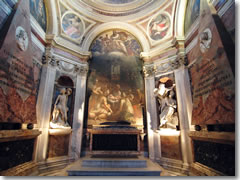 The Chigi Chapel—from left: Sigismondo Chigi's tomb, Lorenzetto/Raphael's Jonah, Sebastiano del Piombo's painting, Bernini's Habakuk and the Angel, and Agostino Chigi's tomb (Photo by Francesco Gasparetti)
When banking mogul Agostino Chigi commissioned his favorite artist, Raphael, to design a memorial chapel tomb for him, he had no idea he'd need it so soon.
Both patron and artist died in 1520, by which time Raphael had barely begun construction on the pyramid-shaped tombs of Agostino and his brother.
Chigi Pope Alexander VII later hired other artists to complete the chapel and ceiling mosaics to Raphael's designs, with God in the center of the dome seeming to bless Agostino's personal horoscope symbols, which surround him.
Sebastiano del Piombo painted the altarpiece and Lorenzetto carved the statues of Jonah and Elijah in the niches to Raphael's designs.
This chapel also takes us into the BAROQUE, with the other niche statues of Habakuk and the Angel and Daniel with his friendly lion (and the gruesome pietra dura skeleton set in the floor) by Bernini.
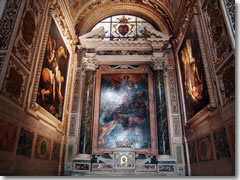
The baroque really comes into its own, though, in the chapel to the left of the altar. Here you're treated to a unique juxtaposition of the two rival baroque masters, Annibale Carracci and Caravaggio.
Crowd-pleasing Annibale was more popular in his day, as the colorful, highly modeled ballet of his Assumption of the Virgin in the center might suggest, but posterity has paid more attention to the moody chiaroscuro of Caravaggio's tensely dramatic, original style.
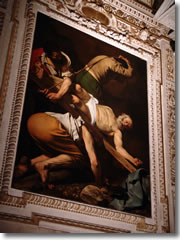
He used overly strong and patently artificial light sources to enhance the psychological drama of The Conversion of St. Paul and The Crucifixion of St. Peter, and to draw the viewer right into the straining muscles, wrinkled foreheads, dirty feet, and intense emotions of his figures.
Why is that important? Well, for one thing the light streaming in through the real window continues right across the frame and into the painted space of Caravaggio's canvases.
What's more, the statues in Raphael's Chigi Chapel are placed so that they tell more complete stories: the angel grabs Habakuk by his hair on one side, ready to carry him and his picnic basket across the chapel to the niche containing Daniel, starving in the den of a rather friendly-looking lion (though perhaps I'm wrong on that score; could be the big cat is licking Daniel's feet not to be cute and cuddly but by way of working up an appetite).
Piazza del Popolo 12
tel. +39-06-361-0836
www.santamariadelpopolo.it
Mon–Thurs 7:15am–12:30pm and 4–7pm
Fri-Sat 7:30am–7pm
Sun 4:30–7:30pm (also open for mass only 7:30am–1:30pm and 6:30–7:30pm)
Free
Roma Pass: No
Bus: 117, 119, 61, 89, 120F, 150F, 160, 160F, 490, 491, 495, 590, M; 81, 224, 628, 926, C3, N25
Metro: Flaminio (A)
Hop-on/hop-off: Piazza di Spagna
Planning your day: I usually spend 30–40 minutes in here because there's just so much to see. » Rome itineraries
Take a guided tour of Santa Maria del Popolo with one of our partners:
You can attend services at Santa Maria del Popolo Monday to Saturdays at 8am, 10am, and 6:30pm; Sundays hourly from 8am to 1pm and again at 6:30pm.
Share this page
Search ReidsItaly.com
Piazza del Popolo 12
tel. +39-06-361-0836
www.santamariadelpopolo.it
Mon–Thurs 7:15am–12:30pm and 4–7pm
Fri-Sat 7:30am–7pm
Sun 4:30–7:30pm (also open for mass only 7:30am–1:30pm and 6:30–7:30pm)
Free
Roma Pass: No
Bus: 117, 119, 61, 89, 120F, 150F, 160, 160F, 490, 491, 495, 590, M; 81, 224, 628, 926, C3, N25
Metro: Flaminio (A)
Hop-on/hop-off: Piazza di Spagna



This article was written by Reid Bramblett and was last updated in March 2014.
All information was accurate at the time.
about | contact | faq
» THE REIDSITALY.COM DIFFERENCE «
åß
Copyright © 2008–2017 by Reid Bramblett. Author: Reid Bramblett