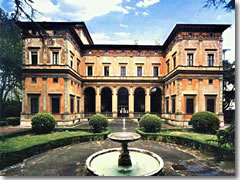
 Baldassare Peruzzi built this modestly sized but sumptuously decorated villa for banking mogul Agostino Chigi in 1508–11.
Lucky for posterity, Chigi had particularly good taste in artists and he hired the likes of Raphael, Sodoma, and the multi-talented Peruzzi to decorate the interior of his sumptuous new villa.
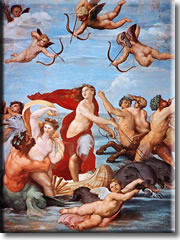
The Loggia of Galatea has a ceiling painted by Peruzzi with Chigi's horoscope symbols, lunettes by Sebastiano del Piombo featuring scenes from Ovid's Metamorphosis, and the famous Galatea by Raphael.
This perfectly composed Renaissance fresco depicts the nymph and her friends attempting to flee on the backs of pug-nosed dolphins from their mermen admirers, with an arch of oft-reproduced cupids hovering above, their arrows of love already taut in their bows.
The ceiling in the Loggia of Cupid and Psyche is frescoed as an open pergola of flowers and fruit that frame scenes from the myth of Psyche, a woman so beautiful Cupid himself fell in love with her.
The fresco cycle was designed by by Raphael, but largely executed between 1510 and 1517 (and restored in the 1990s) by Raphael’s students Giulio Romano, Raffaellino del Colle, and Francesco Penni.
The master himself probably drew up the preparatory sketches and may have daubed his brushes a bit at the plaster as well, but Raphael spent most of the time he was meant to be here working visiting with his girlfriend, La Fornarina, the daughter of a baker who lived a few blocks down the road, just inside the Trastevere gate in the city walls where there is now restaurant bearing her nickname. (Her famous portrait by Raphael hangs in the Palazzo Barberini painting gallery.)
It was after one such visit that Raphael came home with a high fever, which quickly worsened until the young genius died on April 6, 1520 from—and this was the official report—a "surfeit of love." Raphael was buried in the Pantheon.
Chigi, who died the same year, was buried in a now-famous chapel—designed by Raphael, later embellished by Bernini—in Santa Maria Novella.
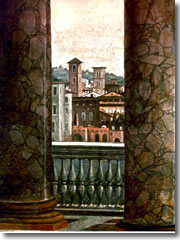
In the grand Sala delle Prospettive upstairs, Peruzzi frescoed every inch of the walls to masterfully carry trompe-l'oeil to its extremes—the name of the room is a bit of a pun, and could be translated either as "Room of Perspectives" or "Room of Views."
The frescoes allowed Chigi to glimpse, straight through the walls, the (slightly idealized) outside world of Roman country and cityscape, peeped from between the painted marble columns of a (fake) open loggia.
It was as if every day were a warm spring day and he could dine al fresco with views of the surrounding countryside.
Even with the frescoes faded by time, Peruzzi’s painterly and architectural tricks create a pretty convincing optical illusion. Notice how, from the correct angles, the room's real flooring and coffered ceiling are continued into the painted space with perfect perspective.
The imperial army of Charles V, sacking the city in 1527, didn't seem to have much respect for this talent, scratching into the frescoes' plaster anti-papal epithets in gothic German script and signing their names and in one place the date (at the time it was vandalous graffiti; time has turned it into a precious historical record to be preserved behind Plexiglas shields).
Awesome Farnesina trivia tidbit: In the 1870s, workers preparing to build the Tiber embankments stumbled across the remains of an ancient Roman villa on this property which turned out to be from the early 1st century and belong to Augustus' son-in-law, the great general Agrippa.
Like its Renaissance neighbor, the ancient palace had been slathered inside with frescoes, many of which were well preserved thanks to having been buried in mud during the Dark Ages from the very Tiber floods the modern embankments were being built to prevent.
One of the rooms of this ancient palace—nicknamed Villa della Farnesina—was a winter dining room, the walls of which were covered in trompe-l'oeil scenes of the surrounding gardens, as if you were dining outdoors under a tent in springtime. Peruzzi himself could have painted it.
More proof that, in Rome, tastes and trends often didn't change all that much, even over 1,500 years.
You can even see for yourself: That ancient frescoed room has been recreated, with its original frescoes, in the National Roman Museum at Palazzo Massimo alle Terme.
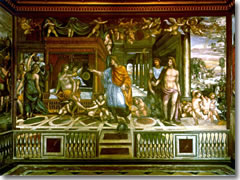
The small bedchamber off this room was frescoed with a delightful scene of the Wedding Night of Alexander the Great by Il Sodoma.
The Tuscan painter frescoed an army of putti helping Roxanne off with her sandals and see-though nightie as Mr. the Great sashays over to join his new bride under the bed canopy (rather less romantic are the Alexander battle scenes frescoed on the room's other walls).
Via della Lungara 230
tel. +39-06-6802-7268
www.villafarnesina.it or www.lincei.it
Mon-Sat 9am–2pm
Open 2nd Sun of each Month 9am–5pm
(Check the website for frequent, though irregular, extended hours on weekends)
€6
Roma Pass: No
Bus: 125; 23, 271, 280, N11
Hop-on/hop-off: Vaticano
Planning your day: Figure spending 45 minutes or so in here.
The villa itself offers guided tours in English Saturdays at 10am (and in Italian Mon, Fri, and Sat at 12:30pm).
Or take a guided tour of Villa Farnesina with one of our partners:
The Farnesina now offer tours in English Satrudays at 10am. (They offer more frequent tours in Italian.)
In recent years, the Villa Farnesina has hosted various combinations of art history tours and concert series—often of period music (i.e.: Renaissance).
These change season to season, but you can usually find information on upcoming concerts at www.villafarnesina.it or www.selectitaly.com.
Share this page
Search ReidsItaly.com
Via della Lungara 230
tel. +39-06-6802-7268
www.villafarnesina.it or www.lincei.it
Mon-Sat 9am–2pm
Open 2nd Sun of each Month 9am–5pm
(Check the website for frequent, though irregular, extended hours on weekends)
€6
Roma Pass: No
Bus: 125; 23, 271, 280, N11
Hop-on/hop-off: Vaticano



This article was written by Reid Bramblett and was last updated in February 2014.
All information was accurate at the time.
about | contact | faq
» THE REIDSITALY.COM DIFFERENCE «
åß
Copyright © 2008–2017 by Reid Bramblett. Author: Reid Bramblett