When a Barberini finally made pope (Urban VIII), the fabulously wealthy family celebrated by hiring Carlo Maderno in 1624 to build them a huge palace, which both Borromini and Bernini later embellished with window frames and doorways.
Since 1949, it has housed half of Rome's National Gallery of paintings, works that span the 13th to 17th centuries (the other half's in Trastevere’s Palazzo Corsini).
The masterpieces are numerous, but while you're admiring the paintings hung on the walls, don't fail to look up at the ceilings, many of which were decorated by one of the masters of Roman baroque frescoes, Pietro da Cortona.
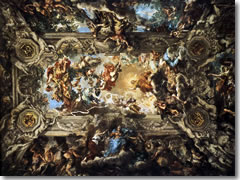
Keep an eye out especially for the Great Hall, where Pietro frescoed his masterpiece, the allegorical Triumph of Divine Providence (1633–39).
This painting of La Divinia Provvidenza celebrates the Barberini dynasty in a sumptuously busy but masterful trompe-l'oeil space open to the heavens with the Barberini bees swarming up to greet Divine Providence herself, who's being crowned by Immortality.
(Few baroque pontiffs were known for their modesty.)
As for the works on the walls, you'll pass icons of art like Filippo Lippi's Annunciation and his Madonna and Child; Andrea del Sarto's Holy Family; Peruzzi's Ceres; Bronzino's precision Portrait of Stefano Colonna; and Guido Reni's Portrait of a Lady believed to be Beatrice Cenci (who was condemned for the murder of her own father).
Other great artists represented here include Filippino Lippi, Sodoma, Beccafumi, El Greco, Tintoretto, Titian, Paul Brill, and Luca Giordano.
Works by two artists really stand out:
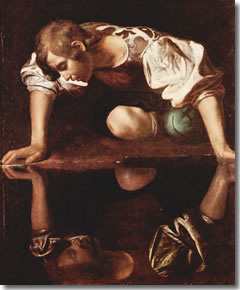
There are also three Caravaggios. The famed Narcissus (pictured up above) shows the young man who gave us the word "narcissistic" staring at his own handsomeness in a pool of water—for which he was rewarded by the gods by being turned into the flower that bends his head toward creeks.
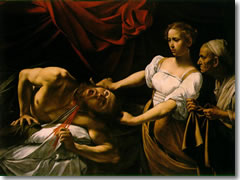
The gory, action-packed Judith beheading Holofernes—check out the creepy old lady to the right, urging Judith on—has been a (rather grim) icon of the women's rights movement across the ages.
For the record: Holofernes deserved it. He was an Assyrian general about to destroy Judith's village; she goes to his tent, seduces him into drinking himself into a stupor, and then takes him out. (If this doesn't sound familiar, it's because this Old Testament story only appears in Catholic and Orthodox versions of the Bible, not Protestant or Jewish ones.)
There's also an St. Francis in Meditation attributed to Caravaggio.
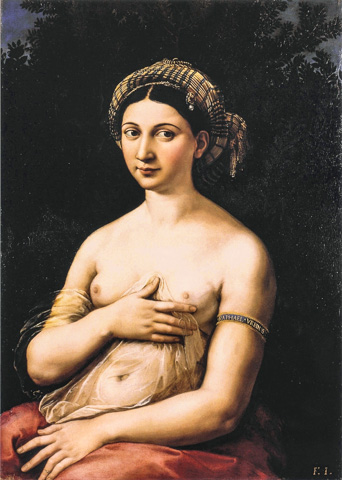
But the star painting has to be Raphael's bare-breasted Fornarina, held to be a (rather racy) portrait of the artist’s girlfriend, a baker's daughter named Margherita Luti.
Some critics say it's actually a painting of a courtesan by Raphael's pupil Giulio Romano, but this would not explain why the lass wears an armband bearing Raphael's name.
In 1936, workers accidentally discovered a mirthaeum underneath Palazzo Barberini. Now open to the public on special guided visits, this 2nd century BC temple to the god Mithras is notable for its amazingly preserved frescoes of the cult's primary ritual—the slaying of a bull (and subsequent bathing in its blood—it was a popular religion among the soldiering class), astrological symbols, and ten small comic-style panels depicting the god himself.
Amazing ancient art, yes; sadly, you can only book a visit for the 2nd and 4th Saturdays of the month (tel. +39-06-3996-7700 or www.coopculture.it).
Via Barberini 18/Via Quattro Fontane 13 (just up from Piazza Barberini)
tel. +39-06-48-14-591
www.barberinicorsini.org
Tues-Sun 8:30am–7pm
€10
Roma Pass: Yes (free, or save 50%)
Bus: 61, 62, 85, 175, 492, 590, 116T, 52, 53, 83, 116, 160, 160F, 175, C3
Metro: Barberini (A)
Hop-on/hop-off: Piazza Barberini
Planning your day:The museum takes about 60–90 minutes to visit on a cursory tour, two to three hours if you're seriously into the art.
Take a guided tour of Palazzo Barberini with one of our partners:
Share this page
Search ReidsItaly.com
Via Barberini 18//Via Quattro Fontane 13 (just up from Piazza Barberini)
tel. +39-06-48-14-591
www.barberinicorsini.org
Tues-Sun 8:30am–7pm
€10
Roma Pass: Yes (free, or save 50%)
Bus: 61, 62, 85, 175, 492, 590, 116T, 52, 53, 83, 116, 160, 160F, 175, C3
Metro: Barberini (A)
Hop-on/hop-off: Piazza Barberini



This article was written by Reid Bramblett and was last updated in March 2014.
All information was accurate at the time.
about | contact | faq
» THE REIDSITALY.COM DIFFERENCE «
åß
Copyright © 2008–2017 by Reid Bramblett. Author: Reid Bramblett