This is not a list of the 10 most important people in the history of Rome. It's a list of ten notables who are perhaps most responsible for the Rome that the visitor encounters.
The pope or emperor who was a great political leader and expanded Rome's influence to the far reaches of the known world is all fine and well as far as history books go—but it's the one who commissioned the buildings or great works of art you stumble over at every turn that makes this list. (For a shortlist of other famous Romans who didn't quite meet this criteria, scroll to the bottom.)
Here's who did make the list—four artists, three popes, two emperors, and a dictator—in rough chronological order. Not all of these men were Roman by birth, but they all came here and left an indelible mark on the Eternal City.
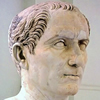 Julius Caesar (100–44 BC) - Gaius Iulius Caesar was a famed Roman general who, among other things, conquered Gaul. After breaking tradition by marching his armies back over the Rubicon River into Roman territory, he turned the old Roman Republic into a dictatorship. He was even more famously assassinated for this action (Et tu, Brute?). It did, however, lay the groundwork for his adopted son Octavian (later called Augustus) to reign as emperor over what became the Roman Empire.
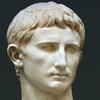 Augustus Caesar (63 BC–AD 14) - The first actual emperor of Rome. Ruled for 52 years of the fabled pax romana, the "Roman Peace" that unified rule brought to all the western European provinces within its aegis. Gaius Octavius Thurinus—"Octavian" to his buddies, though after he was adopted by the Big Man, he took the name Gaius Julius Caesar, and as emperor became simply "Augustus," which means "revered one"—boasted that he "found a city of brick and left it a city of marble." This was a reference to his ambitious public works and building projects that transformed Rome into a city worthy of being the seat of a mighty empire—and set a precedent of investing in infrastructure that most major later emperors took up as well.
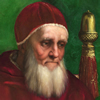 Pope Julius II (1443–1513) - Among many other achievements, this humanist warrior-pope (born Giuliano della Rovere) commissioned the Sistine Chapel ceiling from Michelangelo. Also, Michelangelo designed the pope's tomb.
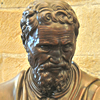 Michelangelo (1475–1564) - Michelangelo Buonarotti—born a Tuscan, but one who lived and worked long in Rome—was being acclaimed as the greatest artist of his age while still a teenager. We know know they were wrong back then. He was, in fact, one of the greatest artists in the history of the human race. Among Michelangelo's masterpieces in Rome: the Pietà in St. Peter's, the Sistine Chapel ceiling and Last Judgment in the Vatican, Risen Christ in Santa Maria Sopra Minerva, Moses in San Pietro in Vincoli, and the the architecture of Santa Maria degli Angeli, the Campidoglio, and the dome of St. Peter's... » more
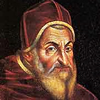 Pope Sixtus V (1521–90) - You know how Rome's street plan consists largely of overlapping trios of streets spreading from major squares, usually each with an ancient obelisk in the center (Piazza del Popolo is the clearest example)? Yeah. That was Sixtus (born Felice Peretti di Montalto), who during his brief papal reign (1585–90) embarked on the grandest overhaul of Rome's civil engineering since Nero rebuilt the city after Rome burned in AD 64.
 Caravaggio (1571-1610) - Michelangelo "Caravaggio" Meresi was probably the most influential painter after Michelangelo on Italian painting style. Caravaggio pioneered the chiaroscuro style of painting, contrasting dark, even black areas of deep shadow with planes of color light by strong light and highlights. He painted in manner that was at once intensely realistic and naturalistic, yet also exaggerated and emphasized—sort of a heightened, hyper-realism. This style would greatly inform the works of Bernini, Ribera, Rubens, Rembrandt, and a host of others down the ages. His masterpieces are spread throughout Rome... » more
 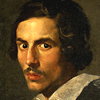 Bernini (1598–1680) - Gianlorenzo Bernini was perhaps the greatest sculptor of the baroque era—not to mention a genius architect and quite a fine painter. Bernini's sculptures are full of life, vitality, and movement, the subjects often caught in a moment of action, the flowing robes and drapery flapping in the wind. Bernini's works are the epitome of the baroque's extravagant theatricality... » more
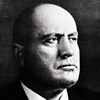 Benito Mussolini (1883–1945) - Yes, he was a terrible Fascist dictator—but he was also responsible for unearthing countless antiquities and creating the vast archaeological park at the center of Rome (he did so ham-fistedly, and in an attempt to link his reign with that of the ancient Caesars, but the fact remains: he did it). He is largely responsible for the restored versions we know today of the Roman Forum, Imperial Fori, Trajan's Markets, Via dei Fori Imperiali, Ara Pacis, and other sights in the heart of ancient Rome. » more
 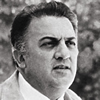 Federico Fellini (1920–1993) - Great Italian film director, many of whose films created the modern mystique of Italy, from the beautiful people lounging at Via Veneto café in 1960's La Dolce Vita (which also gave the world the word "paparazzi") to 1972's Fellini's Roma, his love letter to his adopted hometown—more a series of scenes that a movie with a plot—in which the city of Rome herself is the star.
You'll notice we didn't include:
Oh, and when it came to artists, I had to draw the line at the major heavyweights or this list would have gone on forever.
Planning your day: Rome wasn't built in a day, and you'd be hard-pressed to see it in that brief a time as well. Still, you can cram a lot into just a day or three.
To help you get the most out of your limited time in the Eternal City, here are some perfect itineraries, whether you have one, two, three, or four days to spend in Rome.
Share this page
Search ReidsItaly.com
Public transportation:



This article was written by Reid Bramblett and was last updated in March 2014.
All information was accurate at the time.
about | contact | faq
» THE REIDSITALY.COM DIFFERENCE «
åß
Copyright © 2008–2017 by Reid Bramblett. Author: Reid Bramblett