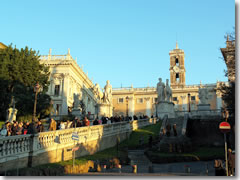
 The Campidoglio (Photo by Pascal Reusch)
 The top of the hill is now marked by the trapezoidal Piazza del Campidoglio, designed by Michelangelo and a favored site for Roman wedding photos. You arrive via a long set of low, weirdly sloping steps that were built to accommodate carriages.
The top of the staircase is guarded by two oversized (but oddly flattened) statues of the dioscuri, Castor and Pollux (see the "Leda and the Swan" box to the right).
A half-hidden little path to the left leads through a miniature garden to the church of Santa Maria in Aracoeli. » more
The pavement of the piazza consists of a complex, twelve-pointed starlike pattern centered around the bronze equestrian statue of Marcus Aurelius, his outstretched hand seeming to bless the city of Rome. This statue is actually a copy created in the 1990s using computers and lasers (real cool). The AD 2nd-century original now sits 30 yards away, behind glass in the Palazzo Nuovo wing of the Capitoline Museums (see below).
The piazza is flanked on three sides by palaces, their facades tweaked by Michelangelo to create a harmonious whole. The central Palazzo Senatorio houses the office of Rome's mayor.
The two side palaces house a twinned pair of Rome's top museums, collectively known as the ★★ Musei Capitolini, or Capitoline Museums, filled with exquisite ancient marble and bronze sculptures, the remains of a colossal ancient statue, and baroque paintings by the likes of Caravaggio, Titian, Rubens, and Il Guercino. » more
The Campidoglio also contains a killer shortcut to the ★★★ Forum. From the main square, walk around the left side of the Palazzo Senatorio, past a public drinking fountain with some of the sweetest water in Rome, and you'll find a stair that winds down along the Forum wall, passing close by the upper half of the Arch of Septimius Severus (great for close-up perusal of its reliefs), and then out around to the Forum's main entrance. » more
Piazza del Campidoglio (up a sloping staircase from Via del Teatro Marcello/Piazza d'Aracoeli, just southwest of Piazza Venezia)
Daily
Free
Bus: 30, 44, 44F, 81, 83, 85, 87, 130F, 160, 160F, 170, 175, 628, 781, C3, 46, 60, 80B, 190F, 780, 916, 916F, N9, N4, N6, N12, N18, N19, N20, N25
Metro: Colosseo (B)
Hop-on/hop-off: Piazza Venezia
Planning your day: The piazza itself takes all of 15 minutes to climb up, see it and walk down—but it is surrounded by excellent sights that easily eat up half a day—and that's before you descend the back side into the Roman Forum. » Rome itineraries
Take a guided tour of Capitoline Hill with one of our partners:
Share this page
Search ReidsItaly.com
Piazza del Campidoglio (up a sloping staircase from Via del Teatro Marcello/Piazza d'Aracoeli, just southwest of Piazza Venezia)
Daily
Free
Bus: 30, 44, 44F, 81, 83, 85, 87, 130F, 160, 160F, 170, 175, 628, 781, C3, 46, 60, 80B, 190F, 780, 916, 916F, N9, N4, N6, N12, N18, N19, N20, N25
Metro: Colosseo (B)
Hop-on/hop-off: Piazza Venezia



This article was written by Reid Bramblett and was last updated in February 2014.
All information was accurate at the time.
about | contact | faq
» THE REIDSITALY.COM DIFFERENCE «
åß
Copyright © 2008–2017 by Reid Bramblett. Author: Reid Bramblett