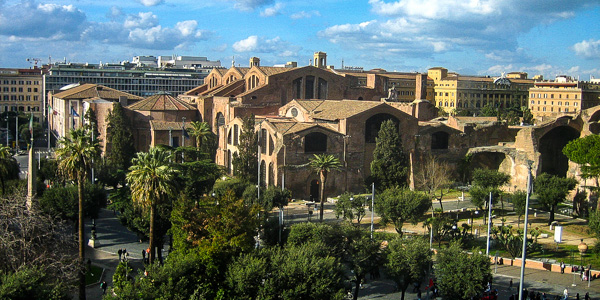
The Terme di Diocleziano (Baths of Diocletian), built at the turn of the 4th century, have been put to various other uses over the centuries, and today you can visit three main parts.
The baths complex was formerly the sole seat of the National Roman Museum of antiquities, closed for more than a decade until the late 1990s saw the collections split up, with the best pieces going to new branches at the Palazzo Massimo alle Terme (nearby) and the Palazzo Altemps (near Piazza Navona).
What remains of the Museo Nazionale Romano in the baths complex itself, reopened in summer 2000, consists of three sections, mostly installed in modernized rooms of a 16th-century charterhouse that occupy large chunk of the baths complex. (The Great Halls of the baths are open to the public only when filled with temporary exhibits.)
There's an extensive epigraphy section whose inscriptions aren’t particularly interesting (even if they are exhaustively explained on English placards), although the early Republican terra-cotta statuary is nice.
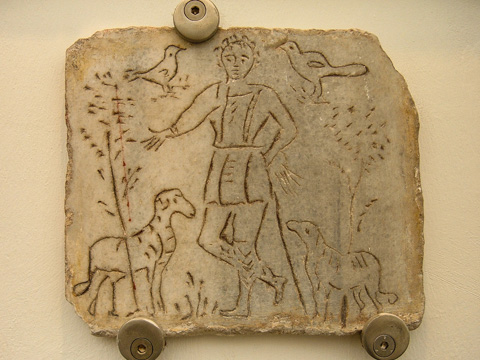
Also intriguing: a few rare shards of marble and pottery decorated with words or drawings referring to early Christianity.
Perhaps the most interesting bit focuses on what Rome was like before there were any Romans—which is to say, before the Latin tribe that lived on and around the Palatine Hill grew, expanded their hegemony, and spread out to conquer, well, pretty much everything.
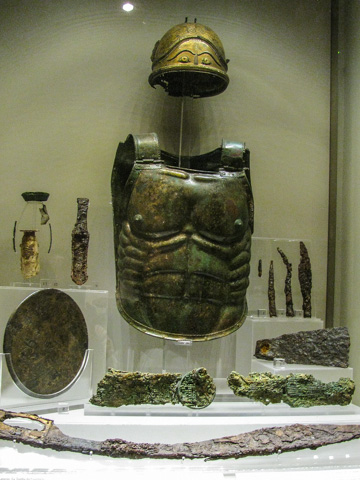
There is the large exhibit on pre-Latin peoples from the area has informative placards to go along with the usual glass cases filled with Bronze and Iron Age pots and tomb paraphernalia, like the 5th century BC arms and armor pictured to the right.
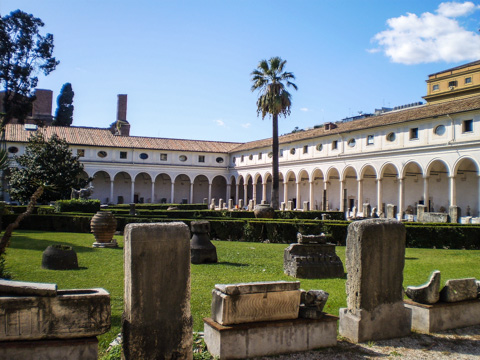
The huge 79m- (264–ft.-) to-a-side Michelangelesque Cloister, supposedly based on a drawing by Michelangelo himself, is lined by headless statues and beat-up sarcophagi.
To catch a glimpse of the ancient structure of the Baths of Diocletian unencumbered by the charterhouse, duck into the exhibit in the sacristy of Santa Maria degli Angeli, a section of the baths converted into a church by Michelangelo. » more
For the best quick sense of the baths as they were, drop by the nearby Aula Ottagona, a huge and airy brick room unadorned save for a funky modern inner webbing (left from its 1928 gig as a planetarium) and—as yet another branch of the Museo Nazionale Romano (yet with a separate entrance)—several excellent oversized ancient statues that came from this and other baths complexes around the city. » more
Via Enrico De Nicola 79, on Piazza dei Cinquecento
tel. +39-06-477881
archeoroma.beniculturali.it
or
www.coopculture.it
Tues-Sun 9am–7:30pm
€8 (sometimes €7, if no special exhibition is on) (free first Sun of month)
Roma Pass: Yes (free, or 35% off)
Bus: 82, 85, 175, 590, 910, 60L, 64, 170, 40, 70, 116T, 170, H, N1, N5, N12, N8, N15, N18
Metro: Repubblica (A) or Termini (AB)
Hop-on/hop-off: Terminal B
Planning your day: Though of historic interest, these exhibits are far from spectacular. Pop in anyway, since admission is included on the cumulative ticket for the other MNR branches, but don't expect to spend more than 30–45 minutes.
(Throw in the other parts of the complex, though—especailly the church of Santa Maria degli Angeli—and maybe you're looking an an hour total.)
The ticket office closes an hour before the museum.
The museum itself offers (free) tours—but only in Italian—at noon on Sundays.
The regular ticket to any one MNR museum includes entry to all branches of the Museo Nazionale Romano for the amazing low price of €7 (you get a week in which to visit them all). However, note that if any branch of the musuem has a special exhibition going (which they almost always do), the ticket price rises to €10.
In other words: Expect admission to be €10, and be pleasantly surprised if they happen to be between exhibitions when you are in town and the price drops to €7.
This is a fantastic deal—though also consider using this as one of the two freebies you get with the Roma Pass (though there are few more expensive sights—the Forum/Colosseum, or the Galleria Borghese—on which you might spend your two "get in free" coupons). » more
I advise against the Archeologia Card,which you will also see offered. This card covers entry to these museums plus the Downtown Ancient Rome group (Roman Forum, the Colosseum, and the Palatine Hill; normally €12), and the Appian Way group (Baths of Caracalla, Tomb of Cecilia Metella, Villa of the Quintili; normally €6).
Sounds good, right? Some major-league sights in there, yes? True: But the savings is actually only €3—and you can get more bang for your sightseeing buck by using the Roma Pass instead to cover the Forum/Colosseum (plus either this group or something else major like the Galleria Borghese). » more
Share this page
Search ReidsItaly.com
Via Enrico De Nicola 79, on Piazza dei Cinquecento
tel. +39-06-477881
archeoroma.beniculturali.it
or
www.coopculture.it
Tues-Sun 9am–7:30pm
€8 (sometimes €7, if no special exhibition is on) (free first Sun of month)
Roma Pass: Yes (free, or 35% off)
Bus: 82, 85, 175, 590, 910, 60L, 64, 170, 40, 70, 116T, 170, H, N1, N5, N12, N8, N15, N18
Metro: Repubblica (A) or Termini (AB)
Hop-on/hop-off: Terminal B



This article was written by Reid Bramblett and was last updated in March 2014.
All information was accurate at the time.
about | contact | faq
» THE REIDSITALY.COM DIFFERENCE «
åß
Copyright © 2008–2017 by Reid Bramblett. Author: Reid Bramblett