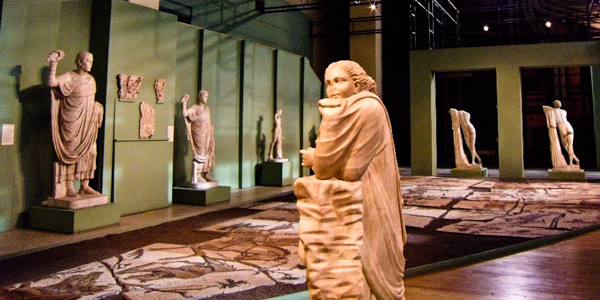
The Acea Art Center is a bona fide deus ex macchina experience.
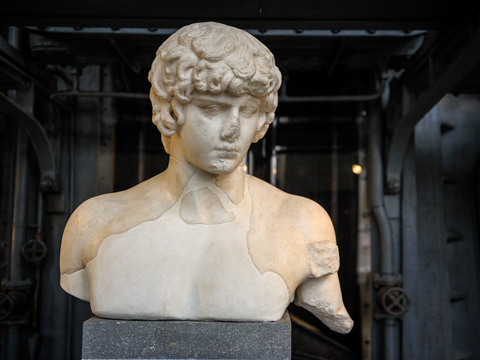
They've prettied up the old Montemartini power plant to house more than 400 gorgeous ancient Roman sculptures from the Capitoline Museums collections that haven't been seen by the public in decades.
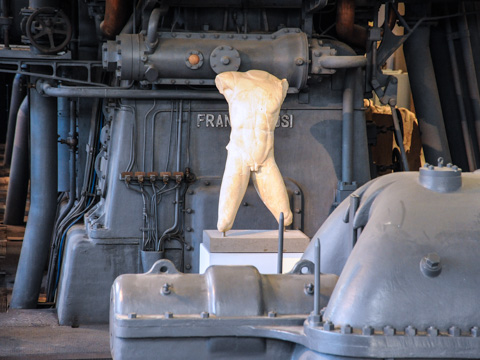
They’re displayed evocatively against a backdrop of the power plant's inky black iron machinery, much of it so massive and muscularly mechanical that it looks more like a metaphor of early industry than actual working devices, like it came from a Fritz Lang movie set.
Past the ticket desk is an excellent Roman replica of a rather sexy 5th-century BC Greek Aphrodite, posing in front of a wood-burning kiln in a filmy dress she's carelessly let slip off to expose one breast.
The first rooms, devoted mainly to art that once decorated public areas, contain fragments of terra-cotta pediments and friezes, marvelous small bronzes, marble busts, and statues—many from the Roman Forum area—as well as remains of a litter and sofa, and fishy mosaics from the 2nd and 1st centuries BC.
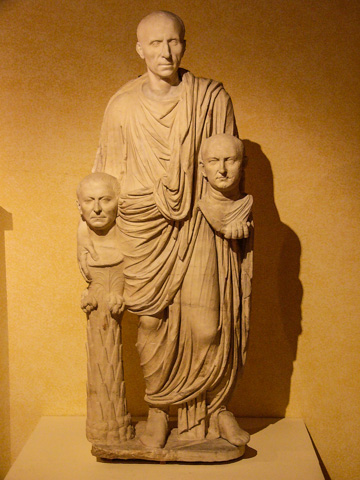
Look for the the well-preserved Togato Barberini. This be-robed patrician hails from the 90s BC and is carrying what appear to be two heads. In Republican Rome, prominent citizens kept hollow wax portrait busts of their illustrious ancestors—in this case, grandpa in the left hand and pop in the right—and wore them during important occasions and ceremonies so as to serve as symbolic stand ins for their deceased progenitors.
In the macchine (machines) room upstairs are preserved two enormous diesel engines around which are arranged late Republican statues, excellent Roman copies of Greek originals, and the arm, head, and feet of what was a 26-foot-tall colossal goddess statue (101 BC) from the Temple of Fortuna in Largo di Teatro Argentina.
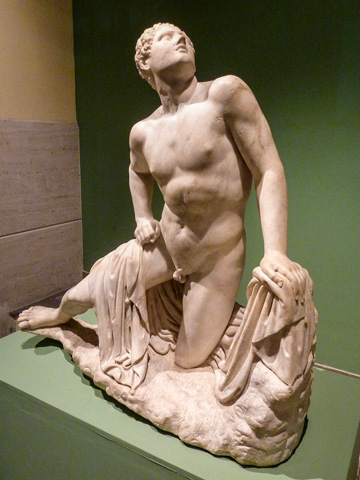
In the caldai (boiler) room up the next set of steps (part of which is pictured at the top of this page) is the collection of pieces that once decorated private Roman homes.
These range from a delicate early Hellenistic Niobe's Son about to get shot by Apollo and Artemis' arrows and the early Imperial Esquiline Venus, to a floor mosaic of a hunting scene.
My favorite is the copy of 2nd-century BC Muse, or Polimnia, carved with a fluidity and symbolist touch that looks almost modern.
Via Ostiense 106
tel. +39-06-0608
www.centralemontemartini.org
Tues–Sun: 9am–7pm
Last admission 1/2 hour before closing time.
€7.50
Book tickets: Select Italy
Roma Pass: Yes (free, or save 15%)
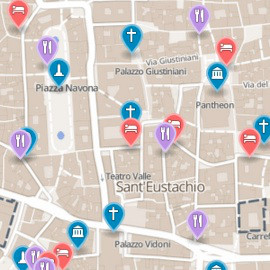
Planning your day: You can see it in about an hour, but I'd spend 90 minutes to two hours inside. Figure in another 40 minutes to get down here and back, as it's well south of the historic center.
They also sell a combined admission ticket that includes admission to the Capitoline Museums. It is a savings (€14 for both—or €10.50, once the Vatican Secret Archives show at the Capitoline is done—whereas individual admissions are €5.50 for Montemartini and €12 for the Capitoline)
Metro B to "Piramide" then bus 23, 271, 769, or 770 down Via Ostiense (ask the driver to let you know when to get off). Or take Metro B to Garbatella and walk west through the ex-Mercati Generali complex
There's really nothing interesting in the immediate vicinity—though you could walk a few blocks south to San Paolo Fuori le Mura; You really just take the bus here and back. However, if you plan to spend this day exploring the scattered sights of Rome's southern reaches, here are some a short bus ride away:
Share this page
Search ReidsItaly.com
Via Ostiense 106
tel. +39-06-0608
www.centralemontemartini.org
Tues–Sun: 9am–7pm
Last admission 1/2 hour before closing time.
€7.50
Book tickets: Select Italy
Roma Pass: Yes (free, or save 15%)



This article was written by Reid Bramblett and was last updated in March 2014.
All information was accurate at the time.
about | contact | faq
» THE REIDSITALY.COM DIFFERENCE «
åß
Copyright © 2008–2017 by Reid Bramblett. Author: Reid Bramblett