- Places
- Plans
- Itineraries
- Experiences
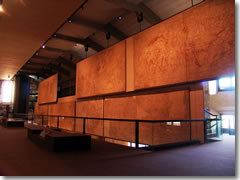
Pisa's Museo delle Sinopie.Across the square from the Camposanto, hidden behind the souvenir stands along the south edge of the piazza, is the Museo delle Sinopie.
This rather unique museum took an artistic tragedy and turned it into an amazing educational opportunity.
After firebombs destroyed many—and severely damaged most of the rest—of the frescoes in the Camposanto, restorers discovered underneath the frescoes blackened remains the sinopie.
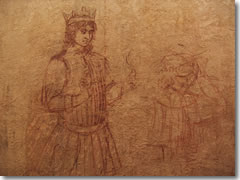
A detail from a sinopia.These rough preparatory drawings were laid down by the various medieval maestros for themselves and their workshops to follow as they painstakingly, day by day, plastered over small sections of the sketch to paint a portion of the final fresco.
(See "Fresco 101" box below to the right for details on the fresco-making process.)
Touring the museum is a bit like playing a giant version of those puzzles on the old Comics Pages comparing two pictures.
Fresco 101 - All in a day's work
In making a fresco, the artist first lays down rough plaster, on which he makes a rough sketch. Then, working in sections, he applies the smooth plaster that will hold the fresco, painting on it while it's still wet, or fresh—fresco is Italian for "fresh." This helps the color bond to the surface.
(Actually in true fresco, the lime mixed into the pigments bonds with the lime in the plaster, which actually pulls the colors just beneath the transparent surface patina as the plaster dries. Neat, huh?)
A frescoist can only lay down as much final plaster as he can hope to finish painting in a single day—each section is called a giornata, or "daily." The size of each giornata can vary widely. When painting a simple background, a good frescoist (or, more commonly, assistant) can whip out a fairly large section at once. When it comes to painting, say, the face of Jesus, Mary, or another major saint, that small face may represent an entire giornata's labor (and only the master would wield the brush).
In restoring frescoes, preservationists often uncover those preparatory sketches—called sinopie after the brownish earthen ink often used to make them (others are drawn in charcoal)—which offer unique insight into the artists' thinking process.
Each full-sized preparatory sketch has a photograph underneath it of an old etching showing what the finished fresco once looked like, so you can compare what the artist originally had in mind with how the finished product came out.
Sometimes positions of arms and legs will change, or characters will be shuffled around, or a saint or two added.
(To see better prints of those 19th century etchings of the lost, finished frescoes, visit the nearby Museo del Duomo.)
★ Museo delle Sinopie
Piazza del Duomo/Campo dei Miracoli (southern edge)
tel. +39-050-835-011 or 050-387-2211
www.opapisa.it
Open Apr–Sept 8am–8pm
Oct 9am–7pm
Nov-Feb 10am–5pm
Mar
9am–6pm
Adm: €5–€42
You could walk through in 15 minutes, but to study the sinopie closely expect to spend more like 30–60 minutes.
You actually only book a specific entry time for the Leaning Tower itself (at least 15 days before your visit at www.opapisa.it), but when you buy that ticket you can also include on it admission to any or all of the other five sights and monuments on the Campo dei Miracoli. You actually only pay for any random one to five other "monument" (see box); you get to pick which ones you want to see once you're here.
Look it sounds complicated, but here's what you do: by everything. Book the Leaning Tower ticket, and then go ahead and buy the ticket for all the other sights. It's just not worth troubling over—especially not for a mere €10 (€8 in winter, when the cathedral is free)—and they're all worth popping into.
Note that you have a specific window in which you can book online: starting 45 days before your visit, but ending 15 days before your visit. In other words, if its two weeks before you arrive in Pisa, you're going to have to hope you get lucky and will be able to find tickets on the day at the ticket desk. (Entry to everything else is always available, so if you don't care to climb the tower, you can just show upon the day.)
Hint: to avoid waiting in the regular Leaning Tower line, while booking tick the box that you want to pick up your tickets either at the Central Ticket Office or the Museo delle Sinopie.
Prefer to leave the driving and arrangements to someone else? Take either a bus tour to Pisa or a private walking tour of Pisa (or Pisa and Lucca) including transport from Florence with a private driver/guide. (Be sure to let them know you want admission to the Tower and other sights in Pisa, though; they'll tack it on to the price.)
Pisa tourist information office
Most convenient location:
Piazza Arcivescovado 8 (in the Museo del Duomo, just behind the Leaning Tower)
tel. +39-334-641-9408
Main location:
Piazza Vittorio Emanuele II 16 (two blocks north of the main train station)
tel. +39-050-42-291
Other locations:
• At the aiport
• Near Ponte di Mezzo (Lungarno Galilei at Piazza XX Settembre)
www.pisaunicaterra.it
www.pisaturismo.it
Pisa tours
Share this page
Search ReidsItaly.com
Pisa tours



This article was written by Reid Bramblett and was last updated in April 2015.
All information was accurate at the time.
about | contact | faq
» THE REIDSITALY.COM DIFFERENCE «
åß
Copyright © 2008–2017 by Reid Bramblett. Author: Reid Bramblett


