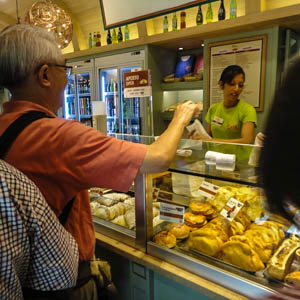
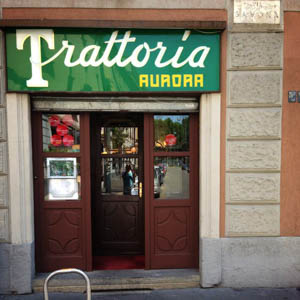
The Milan dining scene
Typical dishes in Milanese cuisine
Milan is the industrial powerhouse of Italy, drawing a mix of international businessmen, fashion designers, media moguls, and tourists by the busload. Milan's industry has also long been a major draw for inter-Italian emigration, so it's no surprise that Milanese restaurants serve a medley of cuisine from across Italy's regions: Apulia's sun-drenched Mediterranean south, Tuscany's vine-draped arcadia in the heartland, Gallic Piemonte hard up against the French Alps.
Reid's Milan Restaurants
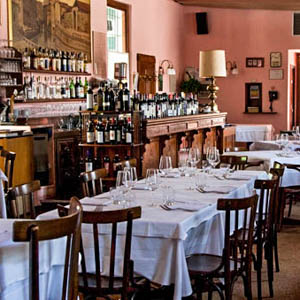
The hand-printed daily menu is pure cucina casalinga (home cooking)—nothing fancy, and plenty of dishes that local mammas invented long ago to make use of the cheapest cuts of meat: insalata di nervetti con cipolle (a cold salad of pickled cow tendons tossed with onions), lingua salmistrata (tongue stew), cuore trifolato (heart casserole). Don't worry, there are plenty of less adventurous choices as well. Marco Ferri packs his guests in elbow to elbow, fitting a trio of lunching businessmen, a young couple, and a lone traveler at a single table set with butcher paper place mats and a single, dime-store glass at each place.
Mon-Sat 12-3pm; Via Cerva 14
...
» more
There is absolutely nothing fancy about Luini, and that's entirely the point. If you come here at lunchtime on a weekday, or during the passeggiata hour (5pm to 8pm), the line—local office workers by day, strollers by evening—will be five or six people thick and stretch out the door and across to the opposite side of this side street near the
Duomo....
Mon 10am-3pm, Tues-Sat 10am-8pm ; Via S. Radegonda 16
...
» more
Since 1981 this osteria—named for the Greta Garbo film, not part of some fancy hotel—has offered a little slice of the countryside in the midst of the big city. It's tucked away far beyond the other trendy restaurants, bars, and clubs that have sprouted all along the canals of the southerly Navigli district.
You must venture south along the canal, cross a highway, and turn left down a blind alley and go through two high gates. Just when you think you must be in the wrong place—and completely lost to boot—there's the doorway that opens into the culinary realm run by Milan native Stefania Zari and her Mantuan partner Fabrizio Paganini. ...
Closed Sun lunch and Mon; Via Asciano Sforza 75
...
» more
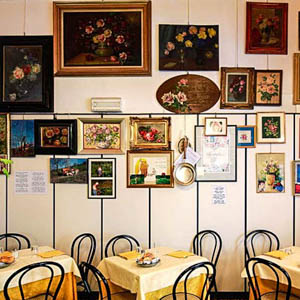
The grub is certainly tasty, in large part due to Arturo's fondness for strongly flavored ingredients such as anchovies, fennel, peperoncino, and horse (which is a common commoner's meat in Italy; if you wish to avoid it, don't order anything called cavallo [horse] or asino [mule]). The high walls are a confusion of framed oil paintings, prints of roses, and the occasional hand-scribbled praise gushing from an old place mat. These invariably compliment Arturo and Maria Maggi on their old-school Milanese cooking and friendly, family-run atmosphere (though not necessarily the service, which is swift but not always on the ball)...
Closed Sat nd Sun; Via S. Marco 24
...
» more
The set-priced menu is, hands-down, the best deal in all of Milan. For less than $40 you get the proverbial soup-to-nuts, wine and water included, starting with a flute of spumanti and a selection of amuse-bouches—tiny sweet-and-soup pickled onions, bell pepper confit, crostini topped with a florette of whipped herbal cheese, wedges of roasted red pepper cupping a dollop of pureed olives, slivers of tender veal swimming in a caper-studded cream sauce, and a pile of delicate lardo (basically the cured fat trimmings from prosciutto). All that before you even start in on the meal itself!
Closed Mon; Via Savona 23
...
» more
Of all the top-flight restaurants in Milan (expect to drop around $120 per person), none is so beloved by its patrons nor so faithful to its cooking fundamentals as "Aimo and Nadia's place."
For more than 40 years, Aimo Moroni's cooking has been firmly based in his native Tuscany's recipes and traditions, but he's not afraid to borrow liberally from Italy's other regional cuisines. Above all, he is big on natural flavors. ...
Closed Sun; Via Montecuccoli 6
...
» more
About a 10-minute walk southeast of Piazza Duomo (Via C. Corenti is an extension of Via Torino, one of the major avenues fanning out from the square), this busy creperie is an ideal stop for a light lunch or a snack while visiting the nearby church of Sant'Ambrogio or Museo Nazionale di Scienza e di Tecnica. The far-ranging offerings include prosciutto e formaggio (ham and cheese), or of the dessert variety (the Nutella, with the creamy chocolate spread, is highly recommended). There are a few value menus: Before 3pm you can get one non-dessert crepe, plus one sweet one and a drink, for 5[eu] ($6); until 9pm you can get two "salty" ones, one dessert crepe, and a drink for 7.50[eu] ($9).
Closed Sun, Mon-Sat: 12pm-3, 4pm-12am
Sun: 4pm-12am; Via C. Corenti 21
...
» more
Giuseppe and Antonella Villa preside with a watchful eye over the centuries-old premises (a restaurant since 1933), tucked into a narrow lane in one of the oldest sections of Milan, just west of the Duomo. In the three-beamed dining room, Milanese families and other patrons share the long, crowded tables. Giuseppe, in the kitchen, prepares what many patrons consider to be some of the city's best traditional fare.
Closed Sun, Mon-Fri: 12:30 – 2:30 pm, 7:30 – 10:00 pm; Via Santa Marta 11
...
» more
The main business here at one time was dispensing milk and eggs to a press of neighborhood shoppers, but now the emphasis is on serving the La Brera neighborhood delicious, homemade fare in a room decorated with paintings and photographs of roses. The minestrone and other vegetable soups are delicious, as are the many variations of risotto, including some otherwise hard to find variations such as riso al salto, a delicious dish of leftover risotto alla Milanese that is fried with butter...
Closed Sat&Sun; Via S. Marco, 24
...
» more
Milan's most famous food emporium offers a wonderful selection of roast veal, risottos, porchetta, salads, aspics, cheeses, pastries, and other fare from its exquisite larder in this natty snack bar around the corner from its shop...
Mon: 3:30-9pm, Tues-Fri: 10am-9pm, Sat: 9am-8pm Sun:10am-5pm; Via Spadari 9
...
» more
One of Milan's most popular pizzerias—any time one of my Milanese friends says "Hey, let's go get pizza!" this is invariably where he or she takes me. Grand'Italia serves up a huge assortment of salads, pizzas, homemade pastas, and focacce farcite (focaccia bread stuffed with cheese, mushrooms, and other fillings)...
Mon-Sun 12–2:30pm; 7pm–12pm; Via Palermo 5
...
» more
This plain but popular trattoria caters to local residents in a middle-class neighborhood, a pleasant enclave of shops and apartment houses east of Stazione Centrale and north of Corso Buenos Aires shopping strip...
Tues-Sun: 8pm–12 am; Closed Mon; Via Temperanza 5
...
» more
Milanese, who tend to be carnivorous, have embraced this refined vegetarian restaurant just north of the public gardens with great enthusiasm. Travelers may welcome the respite from northern Italy's orientation to red meat; those who have become accustomed to smoke-free environments back home will enjoy the non fumatore section of Joia's blonde-wood, neutral-toned dining rooms...
Closed Sat&Sun, Mon-Fri: 12:30 – 2:30 pm, 7:30 – 11:00 pm; Via Panfilo Castaldi 18
...
» more
This outlet of Italy's popular cafeteria chain is not to be dismissed too quickly. Brek takes food, and its presentation, seriously. Pastas and risotto are made fresh; pork, veal, and chicken are roasted to order; the large selection of cheeses would put many a formal restaurant to shame. Excellent wines and many kinds of beer are also available. Behind-the-counter service is friendly and helpful, and the country-style decor is quite attractive....
Mon-Sun: 12-3pm, 6:30-10:30pm; P.tta U. Giordano 1
...
» more
This is one of the more culinarily respectable of the dozens of restaurants around the Navigli, with tables set out on the flagstones overlooking the canal (regulars know to bring tiny cans of bug spray to battle the mosquitoes in summer). The paste e fagioli is livened up with bits of sausage, and the ricotta-stuffed ravioli inventively sauced with a pesto of rucola and veggies...
Mon-Sun: 12:30pm-2:30, 8pm-11pm; Ripa di Porta Ticinese 55
...
» more
The owner hails from Trieste originally (which explains the old Triestino photos on the walls), so kick a meal off with salumi friuliani, a mixed platter of cured meats from the region famous for producing the most delicate prosciutto in Italy. The insalata di pasta is a cold pasta salad with olives, capers, and mozzarella. They do a mean minestrone vegetable soup, Triestino sarde in saor (vinegar-kissed fried sardines), manzo in salsa verde (beef in an herb sauce), and torta di verdure (vegetable quiche)...
Mon-Sat:12pm-3pm, 7pm-11
Sun:12-3pm; Ripa di Porta Ticinese 23
...
» more
The owner hails from Trieste originally (which explains the old Triestino photos on the walls), so kick a meal off with salumi friuliani, a mixed platter of cured meats from the region famous for producing the most delicate prosciutto in Italy. The insalata di pasta is a cold pasta salad with olives, capers, and mozzarella. They do a mean minestrone vegetable soup, Triestino sarde in saor (vinegar-kissed fried sardines), manzo in salsa verde (beef in an herb sauce), and torta di verdure (vegetable quiche)...
Mon-Sun: 12-3pm, 7-11pm; Alzaia Naviglio Grande 2
...
» more
At the Duomo end of the Galleria Vittorio Emanuele II, is best known by its original name, "the Camparino." It holds the dubious distinction of having introduced Italy to what has become the country's ubiquitous red cordial, Campari, a visciously red liquid that tastes like hair tonic even when cut with soda water, as is traditional. You can sample one[md]along with a selection of light dishes to wipe the taste off your tongue (as you might gather, I'm not a fan of the popular Campari-soda)[md]while lingering at the tables set up in the Galleria with a bit of Duomo facade view, or in one of the art nouveau rooms inside...
Closed Mon
...
» more
Since it's only steps from Santa Maria delle Grazie, you can enjoy the old-world ambience and a cup of excellent coffee (or one of the many teas and herbal infusions) as you dash off postcards of The Last Supper. Of course, you'll want to accompany your beverage with one of the elegant pastries, perhaps a slice of the panettone (cake laden with raisins and candied citron) that’s a hallmark of Milan. No one prepares it better than they do at Marches.
Tues-Sat: 7:30am–8pm , Sun: 8:30am–1pm,
Closed Mon; Via Montenapoleone 8
...
» more
Still, most restaurants are built atop a solid foundation of typical Milanese dishes and the cuisine popular in surrounding Lombardy, where the breadbasket plains of the wide Po Valley wash up against the lower slopes of the Alps in Italy's lake district. Lombardy's cooking mixes of lake and river fish, mountain cheeses, and the legacy of the barbarian hordes who settled here after the 5th-century fall of Rome.
Typical Milanese dishes
The Lombards are descended from Germanic, not Latin, stock, so it's no surprise the local signature dish is cotoletta alla milanese, that flattened, breaded veal cutlet more commonly known as wienerschnitzle.
Dining for free in Milan
Want a free dinner in Milan—or at least a hearty snack to stave off hunger until dinner? Do a stuzzichini (snacks) crawl from bar to cafe during the aperitivo /Happy Hour for tons of free bar snacks and scrumptious canapés. » more Saffron-tinged risotto alla milanese is made with small, pearly grains of arborio rice, slow-cooked in broth to sticky perfection. Often, a bright yellow dollop of this rice appears on the plate next to a hearty slab of ossobuco, a beef shank served with the circle of marrow-rich bone still imbedded in the meat.
Tortelli di zucca, the pasta pockets stuffed with a spiced pumpkin paste typical of nearby Mantova, often show up on Milanese menus.
Cassoeûla is, as it sounds, a Milanese version of cassoulet, a stew-thick, cabbage-based soup fortified with meaty chunks of pork chop and sausage.
Many meals feature Northern Italy's signature side dish, polenta, a cornmeal mush that can range from a runny soup to a spackle-thick paste, sometimes cut into bars and lightly fried, sometimes studded with bits of mushroom or other fresh ingredients.
Bread and Cover
There's an unavoidable charge called pane e coperto ("bread and cover") of about €1 to €5 that's added onto your bill at just about all Florentine restaurants. This is not a scam. This is standard in Italy. With the famed Italian lakes (Como, Garda, Maggiore, and many smaller ones) reaching their deep fingers of water into the Alps just north of Milan, and the Mincio River lying to the east, Milan's restaurants are spoilt for fresh fish. To increase the likelihood that you're getting local products, look for the following fishies: persico (perch), trota (trout), lavarevllo and coregone (both forms of whitefish from the lakes), luccio (pike), or tinca (tench).
Cheese & desserts
Lombardy is the proud home of pungent, blue-veined Gorgonzola cheese, as well as its less famous—but just as wonderfully stinky—cousin from nearby Bergamo, the gooey, mold-less taleggio. Grana padana is the local sharp, hard, aged cheese that can hold its own against any parmesan or pecorino romano.
Lombardy also produces the widely exported Bel Paese (the sort of mild, everyman cheese you could throw into a kid's lunch box) as well as marscarpone, so soupy and spreadable that many people mistake it for some kind of heavy cream (understandable, as it's the prime ingredient in such heavenly, creamy desserts as zuppa inglese and tiramisù).
Speaking of dessert, Milan may not win too many awards in this department, and the sweets on its menus tend to hail from other parts of Italy, but we can blame the locals for having invented panettone, a sweet bread studded with bits of candied fruit—the traditional Christmastime dessert (though in its defense, panettone is far, far more palatable than its fruitcake cousins around the world).
Tips & links
Details
General dining tips
- "Pane e coperto" is not a scam: Nearly all Italian restaurants have an unavoidable pane e coperto ("bread and cover" charge) of anything from €1 to €15—though most often €2 to €5—per person that is automatically added onto your bill. This is perfectly normal and perfectly legal (though a few trendy restaurants make a big deal about not charging it).
- Find out if service (tip) is included: Don't double-tip by accident. If the menu has a line—usually near the bottom of the front or back—that says "servizio" with either a percentage, an amount, or the word "incluso" after it, that means the tip is automatically included in the price. (If it says "servizio non incluso," tip is, obviously, not included.)
Even if the menu doesn't say it, ask É incluso il servizio? (ay een-CLOU-so eel sair-VEET-zee-yo)—"Is service included?" If not, tip accordingly (10%–15% is standard).
Don't be stingy about tipping, though. If il servizio is, indeed, already included but the service was particularly good, it's customary to round up the bill or leave €1 per person extra—just to show you noticed and that you appreciated the effort.
- Tourist menus: The concept of a bargain prix-fixe menu is not popular in Italy. Some restaurants do offer a menu turistico ("tourist menu"), which can cost from €8 to €20 and usually entails a choice from among two or three basic first courses (read: different pasta shapes, all in plain tomato sauce), a second course of roast chicken or a veal cutlet, and some water or wine and bread. With very few exceptions, tourist menus tend to live up to their name, appearing only at the sort of tourist-pandering restaurants that the locals wisely steer clear of.
However, a menu à prezzo fisso ("fixed-price menu") is often a pretty good deal, usually offering a bit more choice than a tourist menu.
Then—especially at nicer (and pricier) restaurants—there is the menu degustazione ("tasting menu"), usually far more expensive (anywhere from €25 to €110) that is a showcase of the chef's best, or of regional specialties, and can make for an excellent way to sample the kitchen's top dishes.
- Book ahead: For restaurants that I am truly eager to try, I go ahead and book a table—at least at dinner. I find that a corollary of Murphy's Law seems to apply. If you prudently book ahead, you are likely to show up to a half-empty restaurant and feel a bit like a fool for having worried about finding a table. If, on the other hand, you just show up at the door expecting to find a free table, the place will inevitably be packed and its bookings full for the evening.
Italian dining phrases
| English (Inglese) |
Italian (Italiano) |
Pro-nun-cee-YAY-shun |
| Good day |
Buon giorno |
bwohn JOUR-noh |
| Good evening |
Buona sera |
BWOH-nah SAIR-rah |
| Good night |
Buona notte |
BWOH-nah NOTE-tay |
| Goodbye |
Arrivederci |
ah-ree-vah-DAIR-chee |
| Excuse me (to get attention) |
Scusi |
SKOO-zee |
| thank you |
grazie |
GRAT-tzee-yay |
| please |
per favore |
pair fa-VOHR-ray |
| yes |
si |
see |
| no |
no |
no |
| Do you speak English? |
Parla Inglese? |
PAR-la een-GLAY-zay |
| I don't understand |
Non capisco |
non ka-PEESK-koh |
| I'm sorry |
Mi dispiace |
mee dees-pee-YAT-chay |
| |
|
|
| Where is? |
Dov'é |
doh-VAY |
| ...a restaurant |
un ristorante |
oon rees toh-RAHN-tay |
| ...a casual restaurant |
una trattoria
un'osteria |
oo-nah trah-toar-RHEE-yah
oon ohst-air-EE-yah |
| I would like to reserve... |
Vorrei prenotare... |
voar-RAY pray-note-ARE-eh |
| a table for two |
una tavola per due |
oo-nah TAH-voal-lah pair DOO-way |
| ...for 7pm |
per le sette |
pair lay SET-tay |
| ...for 7:30pm |
per le sette e mezzo |
pair lay SET-tay eh MET-tzoh |
| ...for 8pm |
per le otto |
pair lay OH-toh |
| |
|
|
| I would like |
Vorrei... |
voar-RAY |
| ...some (of) |
un pó (di) |
oon POH (dee) |
| ...this |
questo |
KWAY-sto |
| ...that |
quello |
KWEL-loh |
| chicken |
pollo |
POL-loh |
| steak |
bistecca |
bee-STEAK-ah |
| veal |
vitello |
vee-TEL-oh |
| fish |
pesce |
PEH-shay |
| meat |
carne |
KAR-neh |
| I am vegetarian |
sono vegetariano |
SO-no veg-eh-tair-ee-YAH-no |
| side dish [veggies always come seperately] |
cotorno |
kon-TOR-no |
| dessert |
dolce |
DOAL-chay |
| and |
e |
ay |
| ...a glass of |
un bicchiere di |
oon bee-key-YAIR-eh dee |
| ...a bottle of |
una bottiglia di |
oo-na boh-TEEL-ya dee |
| ...a half-liter of |
mezzo litro di |
MET-tzoh LEE-tro dee |
| ...fizzy water |
acqua gassata |
AH-kwah gah-SAHT-tah |
| ...still water |
acqua non gassata |
AH-kwah noan gah-SAHT-tah |
| ...red wine |
vino rosso |
VEE-noh ROH-so |
| ...white wine |
vino
bianco |
VEE-noh bee-YAHN-koh |
| ...beer |
birra |
BEER-a |
| Check, please |
Il conto, per favore |
eel COAN-toh pair fah-VOAR-eh |
| Is service included? |
É incluso il servizio? |
ay een-CLOU-so eel sair-VEET-zee-yo |
Useful links & resources
- Public transit
- Bus/Metro/Tram: TK
- Airports
- Milano Malpensa: TK
- Milano Linate: TK
- Bergamo: TK
- Airport transfers (Malpensa):
- Bus (€TK; TK min): TK
- Private (€TK; TK min): Viator.com
- Taxi (€TK; TK min): TK
- Airport transfers (Linate):
- Bus (€TK; TK min): TK
- Private (€TK; TK min): Viator.com
- Taxi (€TK; TK min): TK
- Airport transfers (Bergamo):
- Bus (€TK; TK min): TK
- Private (€TK; TK min): Viator.com
- Taxi (€TK; TK min): TK
- Milan rail station
- Milano Centrale: Milanocentrale.it, TK add (TK loc)
- Buses to center: TK
- Car resources
- Emergency service/tow: tel. 803-116
- Highway agency: Autostrade.it (traffic info, serivce areas, toll calculator, weather)
- Italian automotive club (~AAA): Aci.it
- ZTLs: Ztl-italia.blogspot.com (lightly outdated, but handy, links to cities' traffic-free zones)
Share this page

Search ReidsItaly.com