Siracusa (Syracuse) trip planner

A travel guide to lovely, lively Siracusa, Sicily, a major capital of the Ancient Greek world—Home to Archimedes, where they still hold outdoor concerts in the ancient theater and the cathedral is grafted onto a Greek temple

Siracusa tourist info:
Via Maestranza 33, Ortigia
tel. +39-0931-464-255

Via Mirabella 29, Ortigia
tel. +39-0931-464-657
www.comune.siracusa.it

Mainland:
Via San Sebastiano 45
tel. +39-0931-67-710


Hotels in Siracusa
www.booking.com
www.venere.com
www.hostelworld.com

ReidsItaly.com Sicily Map
View Larger Map


TOURS FROM TRUSTED PARTNERS

Intrepid Travel

G Adventures Travel

Siracusa Guide
• Intro
• Sights
• Hotels
• Restaurants
• Planning
Siracusa (Syracuse to some) was settled by Greeks in 733 BC and was the major power in Sicily from 480 BC through the Roman occupation.

With a perfect location at the center of the Mediterranean world, the heritage of this powerful trading port has left the modern city with everything from fantastic ruins—including one of the world's largest intact Greek theaters—and a baroque old quarter to one of Italy's finest archaeological museums and the only stands of papyrus that grow in Europe (supposedly a gift from Egyptian ruler Ptolemy II).

Siracusa makes a great base and good spot to slow down for a day or two, for while it has plenty of top-notch sights to keep you busy, it also sports a relaxed atmosphere, with pleasant cafes, seaside walks, and open-air restaurants to while away the hours.

The long, rich history of Siracusa

Eureka!
Siracusa's most famous son was the great thinker Archimedes, who invented calculus, served as a remarkable military engineer, and discovered the laws of floatation.

The famous legend has it that the philosopher was relaxing into a hot bath one day when he noticed the water level rise in the tub as he sank into it.

The concept of water displacement hit him in a flash, and he was so excited he jumped out and went running through Siracusa's streets naked, shouting "Eureka!" (Greek for "I've found it!").

When the Romans overran the city, they were under express orders to spare the life of the great Archimedes. But the Roman official sent to collect Archimedes at his home grew so impatient with the philosopher, who was caught up in his reading and ignored the soldier entirely, that he ran Archimedes through with his sword.

And to prove not everyone finds calculus boring, a 10th-century manuscript containing the earliest surviving copy of Archimedes’ greatest works sold at Sotheby's in 1998 for $2 million.
As the first city of Magna Graecia and the Mediterranean, Siracusa cultivated local talents like the natural philosopher Archimedes.

Other great thinkers and poets such as Plato, Pindar, and Aeschylus attended the courts of some of its more enlightened tyrants (that was the technical name for a Siracusan ruler in Greek days, though a few bad apples did live up to the word's modern, pejorative meaning).

The city's power and fame grew in the Hellenistic world to surpass even that of Athens. In 413 BC, a jealous Athens sent its fleet to subdue the city, but suffered a humiliating defeat at the hands of the Siracusans.

The Syracuse forces destroyed all 134 Athenian ships and jailed the POWs in squalid conditions in the city's stone quarries (legend holds that only the few prisoners who could recite poems by Siracusan favorites Euripides and Aeschylus were ever released).

The Romans fared better in 212 BC, overcoming the fortifications designed by the versatile Archimedes with the aid of Siracusan traitors, and set up their own governorship of Sicily here that served primarily as a base for corrupt officials to enrich themselves at the fertile and artistically rich island's expense.

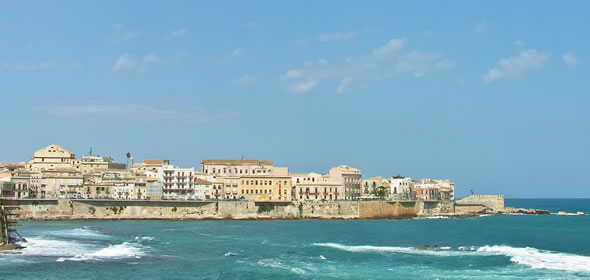
Ortigia Island
Ortigia Island
The city faded from glory when Sicily's medieval Muslim rulers moved the capital to Palermo, but Siracusa remained one of the most important trading ports on the Mediterranean. It's is still a layered joy to explore, where the baroque facade of the Duomo hides a medieval church grafted onto the cella and columns of a Greek temple to Athena.

Even with modern urban sprawl, the ancient Greek Siracusa was about three times the size of the contemporary city. During the medieval and baroque ages it shrank to occupy the easily defensible Ortigia island where the city had been born, while the mainland, a thriving part of the ancient city, was left mostly to farmland.

This area was only redeveloped in the past century—leaving room for an extensive archaeological park amidst the modern buildings. So although baroque Ortigia is considered the "old city," the "new city" of the mainland actually houses the best of the ancient remains, including the Greek theater and archaeology museum.

Planning your time

Related pages


   ShareThis


Search ReidsItaly.com

This material was last updated January 2010. All information was accurate at the time.

about | contact | faq

» THE REIDSITALY.COM DIFFERENCE «

Copyright © 2008–2012 by Reid Bramblett. Author: Reid Bramblett



Google