 |
|||
 |
|||
|
|||


All the Michelangelos in Florence
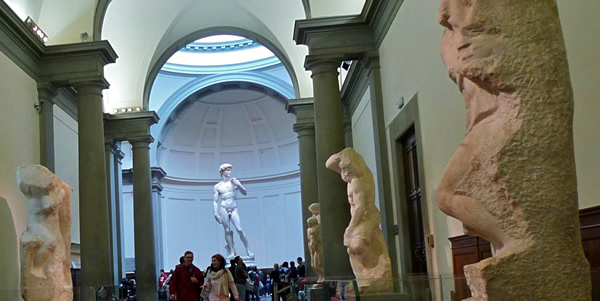
The gallery of nonfiniti Slaves and The David at the Accademia. (Photo by Darren Milligan)
Where to find all the major works—sculptures, paintings, and architecture—by Michelangelo Buonarotti in Florence
• Context: Michelangelo Seminar
• The Genius of Michelangelo
ReidsItaly.com Florence Map
» View ENLARGED MAP with all listings
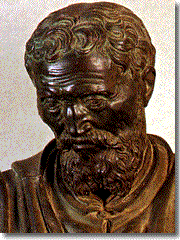
Michelangelo Buonarotti, a bust by Daniele da Volterra in the Bargello.Michelangelo Buonarotti (1475–1564), born to an exceedingly minor Tuscan noble and nursemaided by stonecutter's wife in the hills near Florence, was being acclaimed as the greatest artist of his age while still a teenager.
Supremely talented, divinely inspired, both a great craftsman and insightful innovator, seemingly able to master effortlessly any artistic pursuit he attempted, he would become the High Renaissance's greatest painter and sculptor, and renowned architect, and trusted military engineer. He also wrote excellent poetry.
His fresco palette broke from the staid tradition of primaries-plus-gold and plunged painting into a festive new world of vibrant color. His figures—carved or painted—twisted and turned and carried their weight believably. Every face he created had a character behind it.
His proportions were mathematically precise and his creations exactingly naturalistic—except where they weren't; Michelangelo knew how to distort or exaggerate the rules to achieve an even greater artistic effect (study The David's hands and head sometime; they're all outrageously oversized, yet somehow they look right).
He was also temperamental, whiney, sycophantic without loyalty, and all around a bit of a jerk. On the Sistine Chapel ceiling job, he was utterly dissatisfied with his assistants and ended up firing all of of them save one he kept on to help grind pigments (and, possibly, to help warm his bed at night; though he maintained a deep and spirited friendship with a woman later in life, that relationship was, by all accounts, utterly platonic and Michelangelo was, by all innuendo, gay).
Michelangelo's report card would definitely have read "Does not play well with others." These character faults were unfortunately indulged or endured by those around him because he was so incredibly good at what he did. He was the first artist to be treated like a rock star rather than a common laborer or simple craftsman, and might well be counted as the art world's first true prima donna and enfant terrible.
We forgive him, too, because—hey, we all have faults; we're all human. Michelangelo just also happened to be, quite simply, the greatest artist who ever lived.
Works by Michelangelo in Florence
Sights connected to Michelangelo (but containing none of his works)

Tips
- First-tier Michelangelo sights (miss these and you will regret it): Accademia, Uffizi, Bargello, Medici Chapels.
- Second-tier Michelangelo sights (only true fans will go out of their way): Casa Buonarotti, Museo dell'Opera del Duomo, Santa Trìnita
- Take a tour: Take a guided tour that includes some of the top Michelangelo sights in Florence:
Related pages
- Guided art and architecture walks and museum visits
- Museums in Florence
- Churches in Florence
- Top sights in Florence
- All the Michelangelos in Rome

Search ReidsItaly.com
This article was written by Reid Bramblett and was last updated in March 2013. All information was accurate at the time.
about | contact | faq
» THE REIDSITALY.COM DIFFERENCE «
Copyright © 2008–2013 by Reid Bramblett. Author: Reid Bramblett

- See
- Florence sightseeing
- Florence itineraries
- Top 10 lists
- Top 10 sights in Florence
- Top 10 experiences in Florence
- Top 10 masterpieces in Florence
- Top 10 museums in Florence
- Top 10 free things in Floence
- Top 10 churches in Florence
- Top 10 hotels in Florence
- Top 10 dining experiences in Florence
- Top 10 shopping opportunities in Florence
- Top 10 Florentines you need to know
- Reid's List: Florence
- Florence museums
- Florence churches
- Florence markets
- Florence tours, guides, & cooking courses
- Florence side-trips
- Reid's Florence blog
- Do
- Stay
- Eat
- Plan
 |
 |
 |
 |
 |
 |
 |
 |
 |
 |
 |
 |
Tours from Viator
