The churches of Florence
A list of the top churches in Florence, Italy
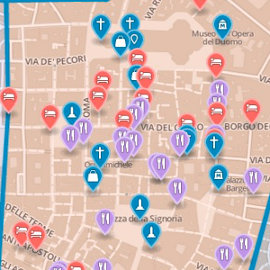
» View ENLARGED MAP with all listings
TOURS FROM OUR TRUSTED PARTNERS that include Florence
Intrepid Travel 2011 Italy trips
• Best of Italy
• Italy Experience
• Classic Italy
• Italy Family Adventure
• Highlights of Italy
• Tuscan Express
G Adventures 2011 Italy trips
• Ultimate Italy
• Italy Culture and History Explored (9 days)
• The Taste of Tuscany
• Venice to Rome Adventure
• Italy Family Adventure

iExplore Italy trips 2011
• Italy Experience (9 days)
• Italy in Style (9 days)
• Magical Tuscany & Portofino Peninsula (10 days)
• Tuscan Delights (8 days)
• Splendors of Italy & Southern France (16 days)

![]()
![]()
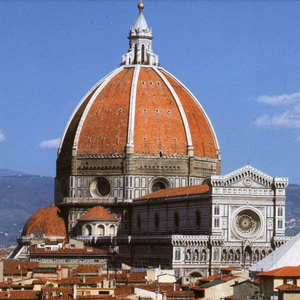
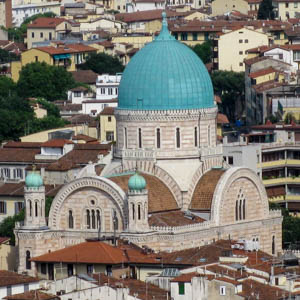
Duomo (Cathedral of Santa Maria del Fiore)—Renaissance frescoes, della Robbia sculptures, Uccello frescoes, and the chance to climb between the onion-like layers of Brunelleschi's Dome, an ingenious feat of engineering that rewards the effort with a city panorama from the top... ![]()

![]()
![]()
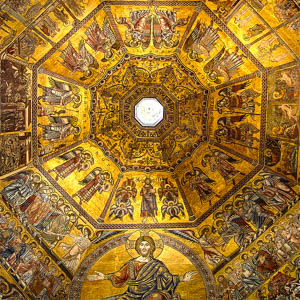
Baptistery—Glittering mosaics inside, and three sets of giant bronze doors, two of which—designed by Lorenzo Ghiberti—are held by many art historians to be the first true works of the Renaissance and which were so beautifully sculpted they were nicknamed "The Gates of Paradise" by none of than Michelangelo himself... ![]()

![]()
![]()
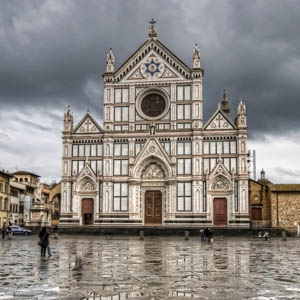
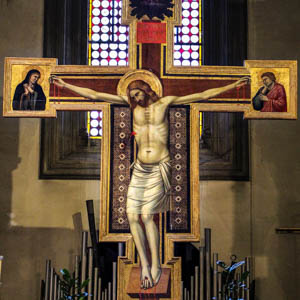
Santa Croce - This big ol' Franciscan barn of a church sports Giotto frescoes, the tombs of Michelangelo, Galileo, and Machiavelli, and a fine leather school in the back...

![]()
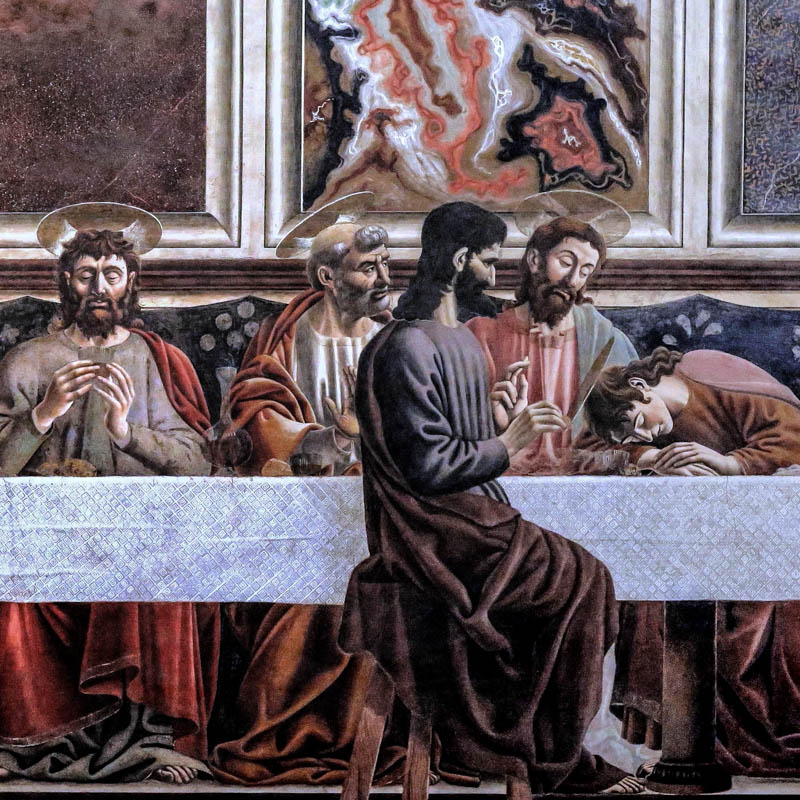
Santa Maria Novella - A church containing some of the seminal works of the early Renaissance, including Masaccio's Trinità fresco, the first use of true perspective in Western art...

![]()
Santa Maria della Carmine - The church's Brancacci Chapel—painted by Masolino and, more importantly, by his innovative student Masaccio—is where a young Michelangelo came to study great art... ![]()

San Lorenzo - The Medici's home church was decorated with works by the family sculptor, Donatello, and its library's staircase is a wonderful example of Michelangelo's felicitous and playful architecture. A separate entrance by the back of the church leads to the "Chapel of the Princes," containing Medici tombs, several decorated with statues by Michelangelo... ![]()

San Miniato al Monte - Florence's only real Romanesque church—with a beautiful facade and a wondrous, moving space inside—perches atop a hill amid greenery in the Oltrarno. For every 10,000 people who say "Oo! Look at that pretty church up there!" and snap a photo of it, maybe one bothers making his way up here to see it up close. Their loss. (Oh, and no matter what the movie showed, it was a vista across the Arno to this church that was the "view" discussed in EM Foster's famous book, "A Room with View.")... ![]()

Santa Trìnita - This was the first Gothic church in Florence, built in 1250–58, perhaps by Nicola Pisano (but likely by a lesser-known artist), and best-known for the richness of its Renaissance frescoes—especially the courtly works by Domenico Ghirlandaio in the Sassetti Chapel—nominally of religious events, but populated by parades of contemporary figures (including Lorenzo de' Medici and his kids) in scenes reproducing faithfully the squares and streets of late 15th century Florence... ![]()

San Marco - The church of San Marco itself is no great shakes—dark and moody, with only a few minor works—but the attached monastery was decorated by its most illustrious resident, the great Renaissance monk and painter Fra' Angelico. It was also later the base of operations for ruling theocrat Girolamo "The Mad Monk" Savonarola... ![]()

Santissima Annunziata - Founded in 1250, this church near the northern edge of the tourist center was rebuilt in 1444-81 by Michelozzo and completed by Leon Battista Alberti, two of the greatest architects of the Renaissance, and decorated by some of the most important Mannerist artists of the High Renaissance... ![]()
Santo Spirito - The blank brick non-facade hides a perfection of Brunelleschian architecture inside, along with some fine altarpieces... ![]()
Orsanmichele - This former granary—which, given its location halfway down the historic center's major street, you'll keep passing as you criss-cross Florence—is ringed by (replica) statues of saints by Donatello, Ghiberti, and Verrocchio, and contains a massive and gorgeous gothic altar by Andrea Orcagna... ![]()
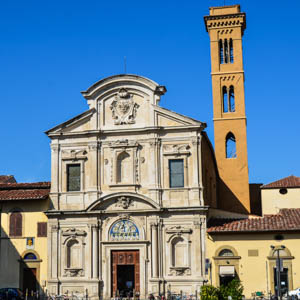
Badia Fiorentina - Florence's only pointy bell tower rises above a Benedictine abbey and Gothic church where Dante once gazed longingly at his Beatrice. The interior has an uninspired baroque overlay, but there are also tombs sculpted by Mina da Fiesole and Bernardo Rossellino, a painting by Giorgio Vasari, several nice but ruinous frescoes by Nardo di Cione, and Filippino Lippi's 1485 Madonna Appearing to St. Bernard. Lovely Renaissance cloisters... ![]()
Santa Margherita de' Cerchi - A tiny medieval church with several Dante associations. Though the Badia was the big church in the neighborhood, most folks worshipped at Santa Margherita de' Cerchi, founded in the 12th century and just up the block from the Dante Museum. This wonderfully spare medieval church has a lovely altarpiece of the Madonna Enthroned with Four Saints by Neri di Bicci, and regularly hosts music concerts...
Tips
- Get ready to pay: Sadly, of the four major churches (The Cathedral, Santa Croce, Santa Maria Novella, and San Lorenzo), only the Duomo is now free—and, sadly, Florence is one of those odd Italian cities where the cathedral is not actually the most interesting church in town (sure, its satellite sites are—the baptistery, Brunelleschi's dome, Giotto's bell tower, the museum—but they all charge admission).
- How to attend mass at a church in Florence: Every church page will list the hours you can attend mass, vespers, Gregorian chant, and other scheduled services. This is not only for the benefit of religiously-minded visitors, but for everybody—Christian, Jew, Muslim, Hindu, Buddhist, and non-believer alike.
You travel to experience the local culture, no? Well, Italy is a deeply Catholic country (heck, it's the Catholic country), and while most modern Italians are fairly non-observant in their daily lives and may only attend church on major holidays, religion and the church still exert a huge influence on Italy's culture and, obviously, its history.
Attending services at least once on your visit is as much a cultural experience as attending a soccer match, taking a cooking class, participating in a festival, or watching an Italian variety show on TV (four other activities I highly recommend).
Related pages
This material was last updated January 2011. All information was accurate at the time.
about | contact | faq
» THE REIDSITALY.COM DIFFERENCE «
Copyright © 2008–2011 by Reid Bramblett. All rights reserved.


ShareThis



