- Places
- Plans
- Itineraries
- Experiences
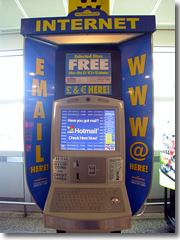 A typical public internet point in an airport; accepts credit cards and cash (U.S. coins, euros, pounds, yen, etc.)Postcards can take up to a week to get home. Sending your jealous friends a quick rundown of what a fantastic vacation you're having via e-mail is instantaneous.
Plus, you can just send it to your own account, bcc everyone you know, and that way you're written a bunch of postcards all at once, plus you have sent yourself an installment of you electronic trip journal.
There are four major types of places where you can get online:
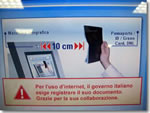
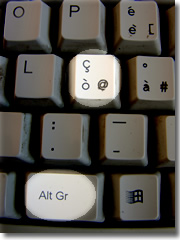 Foreign keyboards are tricky. The letters are sometimes arranged in a slightly different way, but that's merely annoying (for example, in Italy you'll frequently find yourself inserting an extraneous comma where you meant to type an "m"). What's really frustrating is that, not only is "@" not hovering over the "2" key like you're used to, it sometimes seems impossible to get the keyboard to produce the @ ("at symbol") at all, preventing you from addressing emails or making Twitter shout-outs. Here's the secret: Foreign keyboards have a whole extra function key (alongside familiar Ctrl, Alt, Cmd, Option, etc.) called "Alt Gr." If, as in the example above, the @ appears on a key crowded with three or more options, try holding down "Alt Gr" and hitting it. The elusive @ will magically appear.Sometimes there are just out in public, like pay phones; more often you find them in hubs of public communications, like major post offices, phone offices, airports, and tourist offices. I've even run across them in department stores in Milan.
 Then there are all the ways you can jack in with your own equipment, if you happen to be traveling with a laptop or an advanced handheld. (I have a separate page devoted to finding WiFi hotspots).
Oh, sure, I admit that I practice such things myself—just a few years ago, while driving the back roads of Apulia, I used my Palm and a Bluetooth connection to my cell phone to find a movie theater playing the Italian remake of Groundhog Day. Classic.
However, I also think it will be a sad day when our bodies go on vacation but our minds and our virtual selves remain chained to our lives back home, beholden to the email and spending all our spare time surfing the Web. Speaking of which, please read the first "tip" below.
Though I realize none of you is going to take my advice on this one, there is a strong argument for unplugging yourself from the Internet whilst on vacation and ignoring the very existence of such things as e-mail, Facebook status updates, and Twitter feeds while you're on the road.
Let your inbox fill up with spam. Let those anxious emails from co-workers and clients go unanswered. Heroically refrain from updating your Facebook status for days on end. Let the Twtter feed die and the blog roll come to a standstill. Just hang out a virtual shingle to the effect: "Gone Vacationin'. Back in 2 Weeks." Set up your email to bounce back an "out of office/on vacation" message and jack yourself out for the duration.
I'll use a budgetary excuse—postcards are still cheaper than 15 minutes on-line—but really I feel this is a philosophical issue. You're spending a big wad of cash to experience Europe, so don't waste some of that precious time (probably an hour tracking down, and then sitting in, an Internet cafe) keeping plugged into your life back home.
Your work can wait (you're on vacation, remember). Your friends? You can regale them with the tales when you return. Your family? Call them of Skype them as frequently as is appropriate for brief conversations.
True, the Internet is a fabulous tool for making the world a smaller place. But the whole point of travel is to discover how big and diverse the world truly is. Rarely does anyone have thrilling foreign adventures whilst sitting in the glow of a PC screen in a rented storefront. Get out there! Enjoy Italy!
OK, lecture over.
Share this page
Search ReidsItaly.com



This article was written by Reid Bramblett and was last updated in January 2013.
All information was accurate at the time.
about | contact | faq
» THE REIDSITALY.COM DIFFERENCE «
åß
Copyright © 2008–2017 by Reid Bramblett. Author: Reid Bramblett


