
The sights of Naples

Museums, churches, castles, monuments and other sights in Naples

For more info:
www.inaples.it

TOURS OF NAPLES:

Tours of Naples itself:
• Naples City and Pompeii Half Day Sightseeing Tour
• Naples City Hop-on Hop-off Tour
• Small Group Naples City Sightseeing Tour

Tours to Pompeii & Vesuvius:
• Mt Vesuvius and Pompeii Day Trip from Naples
• Pompeii Half-day Trip from Naples
• Naples City and Pompeii Half Day Sightseeing Tour
• Mt Vesuvius Half-Day Trip from Naples

Tours to the Amalfi Coast or Capri:
• Private tour of Sorrento, Positano, Amalfi, and Ravello from Naples
• Capri Day Trip with Lunch from Naples

ReidsItaly.com Naples Map
View Larger Map


TOURS FROM TRUSTED PARTNERS

Intrepid Travel

G Adventures Travel

iExplore
Naples guide
Intro
See
Stay
Eat
Planning FAQ

In the city center

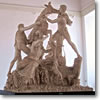
The Farnese Bull at Naples Archeology Museum*** Museo Archeologico - This is one of the most significant archaeological collections in Europe (certainly Southern Italy's best), the only absolutely required sight in Naples, and well worth 2–3 hours of your time. If you explore Pompeii without paying this museum a visit as well, you've missed out on half the riches. The best statues, mosaics, and wall paintings at Pompeii that could be carried off (and hadn't been already by looters) were long ago removed from the archaeological site to be preserved here, alongside finds from across Southern Italy as well as many from Rome itself (including the important and impressive statuary collected by the Farnese family)... Full story

Top 5 sights in Naples
*** Museo Archeologico
** Museo Capodimonte
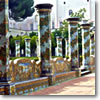
** Santa Chiara
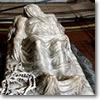
** Cappella Sansevero
* Certosa di San Martino

Il Chiostro di Santa Chiara** Santa Chiara - Santa Chiara is the most rewarding of Naples' churches, built in 1328 and half-destroyed by incendiary bombs in 1943. It was restored as best as possible to its Gothic state in 1953—complete with its famous and gorgeous majolica-plated cloisters... Full story

The Cristo Vellato in Sansevero Chapel** Cappella Sansevero - If you want the best example of how baroque can be both ludicrously over-the-top, hauntingly beautiful, and technically brilliant all at once, search out the nondescript entrance to one of Italy's most fanciful chapels. This 1590 chapel is a festival of marbles, frescoes, and above all sculpture—in relief and in the round, masterfully showing off the considerable technical abilities and intricate visual storytelling of a few otherwise relatively unknown Neapolitan baroque masters... Full story

* San Lorenzo Maggiore - The greatest of Naples' layered churches was built in 1265 for Charles I over a 6th-century basilica, which in turn lay over the remains of the ancient Greek and Roman cities (the foundations of the church are actually the walls of Greek Neapolis' basilican law courts.) The interior is pure Gothic, with tall pointed arches and an apse off of which radiate nine chapels. This is where, in 1334, Boccaccio first caught sight of Robert of Anjou's daughter Maria, who became "Fiammetta" in his writings... Full story

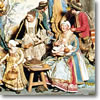
Presepi di Napoli* Presepi (Christmas crèches) - These dioramas of the Nativity, which probably date back to St. Francis of Assisi in the 13th century but became most wildly popular here in Naples starting in the 17th century, are still an integral and important part of the Christmas season, assembled in church chapels and on piazze throughout Italy starting in November. Presepi seem to concentrate more on finely studied figures of peasants and townsfolk than the Holy Family itself... Full story

* Duomo (Cathedral) - The neo-Gothic facade of Naples' cathedral—built in the French Gothic style for Charles I in 1294 but rebuilt after a disastrous earthquake in 1456. The third chapel on the right is the sumptuous 17th-century Cappella di San Gennaro, elaborately frescoed by Domenichino and, later, Giovanni Lanfranco, who completed the concentric clouds of saints and angels spiraling up the airy dome to celebrate the city's patron saint and his miraculous blood... Full story

San Domenico Maggiore - This massive Gothic edifice was erected from 1289–1324, and rebuilt in the Renaissance and early baroque eras (when it received its prime attractions inside)... Full story

San Gregorio Armeno - The church was founded by devout 8th-century nuns who fled the persecutions in Byzantium, taking the relics of St. Gregory with them. But the baroque-era members of the sisterly order tended to be wealthy daughters of noble families, and so their church was decorated in a suitably rich rococo style... Full story

Museo Civico G. Filangeri - A small, private house museum with an eclectic collection—paintings by Ribera, Mattia Preti, and Luca Giordano; porcelains; Asian arms—in a late–18th century palazzo complete with grand salons, a library, and a preserved majolica floor up on the first floor... Full story

By the waterfront

Teatro San Carlo** Teatro San Carlo - San Carlo is one of the oldest, largest, and most respected opera houses in Italy, built by Giovanni Medrano in 1737 under the auspices of Charles of Bourbon (who didn't particularly care for opera, but cared very much about his reputation as an enlightened patron of the arts)... Full story

Galleria Umberto I in Naples* Galleria Umberto I - This early shopping mall—modeled on Milan's galleria—was built as part of Naples' urban renewal scheme following a cholera epidemic of 1884. The massive glass and iron-frame barrel vaults of its four wings and central dome soar some 187 feet above the inlaid marble flooring... Full story

Palazzo Reale a Napoli* Palazzo Reale - Naples' royal palace had to be restructured following Allied bomb damage in 1943, but retains some sumptuous royal apartments and, in niches along the 18th-century facade, statues of the greatest kings from the eight dynasties that have ruled Naples... Full story

Piazza PlebescitoPiazza Plebescito - The expansive Piazza Plebescito in front of the royal palace is one of Naples’ largest open spaces, laid out with a colonnaded hemicycle and equestrian statues of Charles III of Bourbon and Ferdinand IV in the early 18th century... Full story

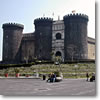
Castel Nuovo, NapoliCastel Nuovo - Though the core Maschio Angioino, or Angevin Dungeon, was built in the 13th century, the grand entrance arch wedged between two massive 15th-century bastions is pure Renaissance. Inside are statues and frescoes from the 14th and 15th century, a middling collection of paintings from the 15th to 20th centuries, and the huge Sala dei Baroni hall where Naples' City Council still meets... Full story

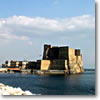
Castel dell'Ovo, NapoliCastel dell'Ovo - On an ancient island just off the Santa Lucia headland, the Greeks built a fortification that was later adapted by the Romans and connected to the mainland by a pier. One of Naples' most ingrained legends is that hometown poet Virgil locked a magic egg (ovo in Neapolitan) in an iron cage under this castle, and should that egg ever break, Naples itself will crumble. Certainly this strategic spot at the edge of Naples' Bay has been key to the city's defenses for over 2,600 years... Full story

In the hills

A Ribera in the Museo Capodimonte, Napoli** Museo Capodimonte - Set in an 18th-century royal palace in the midst of shady, grassy Capodimonte park high above the city, this is by far the best painting gallery in all of Southern Italy, particularly strong in works from Old Masters representing all phases of the Renaissance and baroque periods, including notable works by Caravaggio and Ribera... Full story

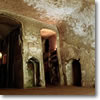
Catacombe di San Gennaro* Catacombe di San Gennaro - These wide tunnels lined with early Christian burial niches grew around the tomb of an important pagan family, but became a pilgrimage site when the bones of San Gennaro himself were transferred here in 5th century. Along with several well-preserved 6th-century frescoes there is a depiction of San Gennaro from the AD 400s whose halo sports an alpha and omega, and a cross—symbols normally reserved exclusively for Christ's halo... Full story

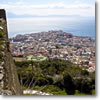
The view from the Certosa di San Martino* Certosa di San Martino - This 14th-century Carthusian monastery was baroqued in the 17th century, and is today famous for its fine church, peaceful cloisters, great views, small painting gallery, and remarkable presepio collection of Christmas crèches. What's more, the views across the city below from its perch atop Vomero hill are fantastic... Full story

Castel Sant'Elmo, NapoliCastel Sant'Elmo - Next door to the monastery of San Martino is the star-shaped Castel Sant'Elmo, built in a strategic position above the city in 1329–43 by the Angevins. It was enlarged in the 16th century and today offers a magnificent 360° panorama of Naples and its bay after a walk through the dark, echoey, medieval stone halls... Full story

Tips

Related pages


   ShareThis

Intrepid Travel

Search ReidsItaly.com

This material was last updated August 2010. All information was accurate at the time.

about | contact | faq

» THE REIDSITALY.COM DIFFERENCE «

Copyright © 2008–2011 by Reid Bramblett. All rights reserved.

