 |
|||
 |
|||
|
|||


The Medici
The family that ruled Florence
• Context: Medici: Portrait of a Family
• Art and Excess at the Court of the Medici Grand Dukes
• Science and Art in the Age of Galileo
• Context: Renaissance Gardens and Villas (Villa Medici and Villa Gamberaia)
• Guided Visit to the Medici Chapels
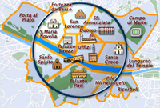
ReidsItaly.com Florence Map
» View ENLARGED MAP with all listings
I promise to write a proper section on this soon. The Medici family is terribly important to Florentine history—a major banking family that rose to become the city's most prominent citizens in the 15th century, then rulers in all but name.
By the 16th century—following a few interregnums when republican forces kicked them out and a kind of democratic rule prevailed (plus Savonarola's brief reign as a theocracy)—the Medici became, under Cosimo I, the city's rulers in actual fact—first as Dukes of Florence, then as Grand Dukes of Tuscany.
Prominent early Medici
Cosimo "Il Vecchio" de' Medici ("Pater Patriae") - (1389–1464) - Founded the dynasty's fortunes by expanding his father Giovanni di Bicci's financial empire to become personal banker to various European kings and, crucially, the papal curia in Rome while also making himself an indispensable advisor to the city council. Nicknamed "Father of his Country."
Piero di Cosimo de' Medici ("The Gouty") - (1416–1469) - Son of Cosimo Il Vecchio; father of Lorenzo the Magnificent. Skilled (if short) reign as head of family, but chiefly remembered as the bridge between two greater generations.
Lorenzo de' Medici ("The Magnificent") - (1449–1492) - Godfather of the Renaissance, the most powerful man in Florence (prince of the city in everything but title), noted humanist philosopher (he gathered great books to the Medici library), and an excellent poet in his own right.
He survived a dramatic assassination plot known as the Pazzi Conspiracy that actually went down in the Duomo during mass and claimed the life of his younger brother Giuliano. He is perhaps chiefly remembered, however, as the greatest patron of the arts in history.
The list of artists he either discovered, supported, or encouraged in their careers reads like a who's-who of Old Masters: Leonardo da Vinci, Botticelli, Michelangelo, Ghirlandaio, Verrocchio, and others.
The Medici achieve new highs and new lows
The Medici Popes
While lesser Medici reigned—or were chased out of—Florence, the true inheritors of family power were playing on a much bigger stage as popes in Rome.
Pope Leo X (1513–1521) - Lorenzo's The Magnificent's second son, Giovanni de' Medici (1475–1521), is chiefly remembered for commissioning Raphael to paint his Vatican apartments, for battling it out (with papal bulls and denunciations) with some smarmy German upstart theologian named Martin Luther, and for supposedly proclaiming: "God gave us the papacy; now let us enjoy it!"
Pope Clement VII (1523–1534) - Giulio di Giuliano de' Medici (1478–1543), the illegitimate child of Lorenzo The Magnificent's slain brother Giuliano, is chiefly remembered for presiding over the papacy during the 1527 Sack of Rome by the troops of Charles V. That and, while hiding out in Orvieto, telling that pesky English king Henry VIII that no, he couldn't have an annulment of his marriage just because his wife, Catherine of Aragon, hadn't born him a son, thus inadvertently causing the creation of the Anglican Church (and one of history's most famous serial marriers). This might have been, in part, for fear of antagonizing even further Catherine's nephew... Charles V.Piero II ("The Unfortunate") - (1472–1503) - Lorenzo the Magnificent's eldest son, Piero II ("The Unfortunate"), turned out to be a terrible civic leader and in 1494 (with the help of Charles VIII of France) was hounded from Florence after just two years in power.
After experimenting with theocracy courtesy of the firebrand preacher Savonarola, Florence became a Republic in 1498 and remained so for 15 years.
It was not until Lorenzo the Magnificent's second son, Giovanni, ascended from cardinal to become Pope Leo X (see box to the right), he had the muscle to wrest control of Florence back in 1513.
Lorenzo II ("Duke of Urbino") - (1492–1519) - In 1513, Pope Leo X installed his nephew, Piero's son Lorenzo II ("Duke of Urbino") as the new ruler of Florence at the ripe old age of 21.
Lorenzo II was dead of syphilis by 1519.
The most significant things he accomplished were (a) to have a local noted political thinker named Niccolò Machiavelli dedicate to him his new treatise on how to govern, titled "The Prince;" and (b) to have a tomb in the Medici Chapels decorated by Michelangelo.
They were running out of Medici.
Giulio di Giuliano de' Medici ("Pope Clement VII") - (1478–1534) - Pope Leo X's cousin and the illegitimate son of Giuliano (Lorenzo's the Magnificent's slain younger brother)—had been made Archbishop of Florence by his papal cousin in 1523.
After the death of Lorenzo II, Giulio oversaw city affairs as the head of the Medici in Florence for a few years, but he had his sights set higher. The moment his cousin Leo X died, Giulio returned to Rome to begin trying to become pope himself.
(He succeeded, two years later, taking the title Pope Clement VII; see box above.)
Ippolito de' Medici (1511–1535) - Ippolito was the illegitimate only child of Giuliano, Duke of Nemours—the last of Lorenzo The Magnificent's sons—who died when Ippolito was five. Ippolito was raised by his uncle Giovanni and cousin Giulio—the two Medici who went on to become popes.
When Cardinal Giulio lit out for Rome, he nominally left Ippolito (and his cousin Alessandro, about whom more in a moment) in charge of the Medici party.
Once Giulio became Pope Clement VII in 1523, he officially installed Ippolito as ruler of Florence.
Ippolito distinguished himself except by enjoying himself thoroughly and ignoring his duties. That and carying on a torrid love affair with his teenaged cousin Catherine de Medici (a daughter of Lorenzo II, Duke of Urbino; if her name seems familiar, it's because she would marry King Henry II of France and become the mother of, and regent to, three of her sons who each became French kings in succession).
He ended up being hounded from Florence by its citizens in 1527 while the true family patriarch, Pope Clement VII, was too busy to help—what with being made prisoner in his own Vatican thanks to the Sack of Rome (see box above).
Clement eventually foisted off poor Ippolito with a cardinal's hat and sent him scurrying around Europe (Avignon, Hungary) as a papal legate.
Ippolito died of malaria in northern Lazio—though there is a reliable rumor he was actually poisoned by his old comerade/cousin/rival, Alessandro "Il Moro," the big brother of Catherine who had since become not only ruler of Florence. He was its Duke.
Alessandro de' Medici ("Il Moro") (1510–1537) - Once Clement VII made up with Charles V and was back in power, he regained control of Florence and installed as ruler Lorenzo II's son Alessandro de' Medici.
Alessandro was yet another illegitimate child (and rumor was he was not the bastard son of Lorenzo II at all, but rather the bastard son of Clement VII himself, likely with a serving girl).
However, he was also the only male heir of the main Medici line, so he got the job as city ruler in 1530 at the age of 19. He also got a shiny new title: Duke of Florence—the first Medici actually to hold a noble title (purchased for him from Charles V by his Uncle/Daddy, Pope Clement VII).
Alessandro proved himself every bit as "worthy" a ruler as his cousin Ippolito had been—but Florence never had a chance to get tired enough of him and his carousing to send him, too, packing.
One night in 1537, Alessandro went to teh the house of his cousin Lorenzino (also called Lorenzaccio, or "Bad Lorenzo") for what he thought was going to be a romantic assignation with a woman—some even say with Lorenzino's sister, which would make her yet another cousin. Ew.
Instead, waiting for him in the bed was Lorenzaccio himself, along with a hired assassin. The two stabbed Alessandro to death before fleeing the city.
Exciting stuff, history, eh?
Thus endeth, in sad and sordid disarray, the Medici line of Cosimo Il Vecchio.
The Medici become Grand Dukes
Cosimo I de' Medici ("The Grand Duke") - (1519–1574) - Cosimo was a distant cousin of the main Medici line, descended from Cosimo Il Vecchio's younger brother, Lorenzo (called by history "The Elder" the help distinguish him from "The Magnificent" who came later).
He was put in his position by more powerful men who assumed they could control this young and relatively undistinguished cousin.
Turned out, young Cosimo was destined to become the most powerful Medici yet.
This was the Medici who turned the family from Florence's foremost banking concern, citizen-leaders, and nominal Dukes of Florence into the Grand Dukes of Tuscany and major players on the European scene.
He also took on the family mantle as a leading patron of the arts (Vasari, Cellini, Pontormo, Bronzino, etc.). He also built the Uffizi (to serve as the family's offices) and enlarged the Pitti Palace (the family shack).
The Long Snooze
Cosimo’s descendants continued to rule Florence and Tuscany in a pretty even, if uneventful, manner. Few Medici stick out, and Florence had already begun its long economic decline as a European power.
The Grand Dukes became increasingly pretentious, but for the most part harmlessly. Most did uphold the family intellectual tradition of patronizing the arts (unfortunately, many had a remarkable lack of good taste) and defending the sciences. Here are a few of the highlights... and lowlights.
Cosimo II de' Medici - (1590-1621) - Chiefly remembered for patronship of the sciences, and for making sure that Pisan scientist Galileo got a scetence of house arrest (rather than simply being executed by the Inquisition) for his heretical view that the Earth revolved around the Sun.
Ferdinando II de' Medici ("The Epitome of the Grand Snooze Years") - (1610–1670) - During the long 49 years of bookish, genial Ferdinando II's reign as Grand Duke, the last of the Medici banks closed. Yep. That's about the most significant thing that happened. (OK, so he was obsessed by new tech, and encouraged scientific study. But other than that...)
Gian Gastone de' Medici ("The Last Grand Duke") - (1672–1737) - The last Medici Grand Duke started off well enough—he abolished taxes on the poor, undid local anti-Semitic laws, and forbade public executions—but a bad marriage to a harpy of a Bohemian wife drove him fairly early to become an obese sensualist who spent those few hours when he was not passed out in a wine-sodden stupor playing with nubile young men in bed.
He barely showed his face outside of the Pitti Palace—except on one memorable carriage ride through town to prove he was alive, during which he occupied himself by vomiting out the window onto his subjects.
No one mourned his passing in 1737, when the Grand Dukedom passed to the Austrian Lorraine family, married into the Medici line for years. (Fun fact: It passed to Francis III of Lorraine, a.k.a. Holy Roman Emperor Francis I, a.k.a. Marie Antoinette's daddy.)
The Lorraines—although they sponsored initiatives like the 1824 plan to reclaim the Maremma—ruled with a much heavier hand and, even worse, a general disregard for traditional Florentine values. The citizens found themselves almost missing the Medici.
Anna Maria de’ Medici ("The Last Medici") - (1667–1743) - Gian Gastone was survived by his sister Anna Maria de’ Medici, a devout and dignified lady. Upon her death in 1743, she did something novel.
She willed that the new Lorraine Grand Dukes would inherit the Medici’s vast and mind-bogglingly valuable collection of art, manuscripts, furniture, books, and jewelry.
She only had one condition: None of it could ever be removed from Florence, and it all had to be made available to the public.
The museums of the Uffizi, the Pitti Palace, and the Bargello are just the beginning of the artistic legacy Anna Maria created for Florence. She alone was probably the single greatest progentior of the city's current status as one of the world’s greatest tourist and artsitic Meccas.
Thank you, Anna Maria.
Tips
- Take a tour: Take a Medici tour of Florence:
Related pages
- Notable Florentines
- Top 10 lists
- Florence itineraries - What to do if you have 1 day, 2 days, or 3 days in Florence
- Florence FAQ
- Florence homepage

Search ReidsItaly.com
This article was written by Reid Bramblett and was last updated in April 2013. All information was accurate at the time.
about | contact | faq
» THE REIDSITALY.COM DIFFERENCE «
Copyright © 2008–2013 by Reid Bramblett. Author: Reid Bramblett

- See
- Florence sightseeing
- Florence itineraries
- Top 10 lists
- Top 10 sights in Florence
- Top 10 experiences in Florence
- Top 10 masterpieces in Florence
- Top 10 museums in Florence
- Top 10 free things in Floence
- Top 10 churches in Florence
- Top 10 hotels in Florence
- Top 10 dining experiences in Florence
- Top 10 shopping opportunities in Florence
- Top 10 Florentines you need to know
- Reid's List: Florence
- Florence museums
- Florence churches
- Florence markets
- Florence tours, guides, & cooking courses
- Florence side-trips
- Reid's Florence blog
- Do
- Stay
- Eat
- Plan
 |
 |
 |
 |
 |
 |
 |
 |
 |
 |
 |
 |
Tours from Viator
