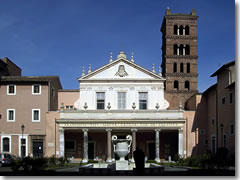
 The rather bland, 18th-century interior of this convent church hides the fact that it dates from 820, and contains not only one of the greatest frescoes from late medieval Rome, but also the ruins of a Roman patrician house underneath.
The house —parts which you can still visit underneath the church—was, supposedly, once the home of Saint Cecilia.
Cecilia was a powerful Roman patrician who was killed in AD 230 for complicated political reasons—most of which had to do with the fact that she was (a) influential, (b) vocal in her politics, and (c) a woman.
Since the Roman prosecutors used her devotion to the then-illegal cult of Christianity as the chief accusation against her, she also became an early martyr of the church (see the box to the right).
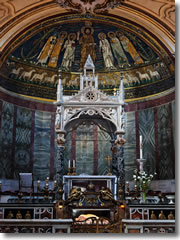
The bulk of the interior is a yawning dull take on baroque style, but the lovely mosaic in the apse dates from the ninth century, when Pope Paschal I rebuilt the church and brought Cecilia’s body from the catacombs to rebury her beneath the altar.
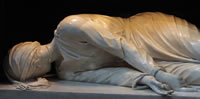
Under the present altar, with its Guido Reni painting and beautiful Arnolfo di Cambio baldacchino of 1283, lies Stefano Maderno’s touching 17th-century statue of St. Cecilia. She is lying on her side in repose with her face turned from us, a slit across her neck the only sign of her violent death.
Maderno was on hand to make sketches when Cardinal Sfondrati opened the saint's tomb in 1599, and they found Cecilia perfectly preserved under a gold funeral shroud.
From a door on the left aisle, you can pay a few euro to descend to the basement and wander around those Roman ruins beneath the church (as well as see the odd, riotously decorated crypt under the altar).
This closes half an hour before the church itself.
Be sure afterward to ask the nun on duty if you can please see the “affreschi di Cavallini”—traditionally viewable only on Tuesdays, Thursdays, and Sundays, but lately on other dasy as well. (If no one is on duty, ring the bell at the door on the left aisle; you’ll have to pay the nun a few euro to walk you up to the frescoes.)
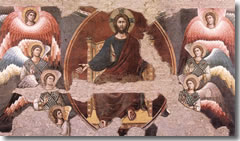
In doing so, they unintentionally preserved the fresco’s top half, and what remains here of Christ, the angels, and apostles is stunning.
Cavallini painted this in 1293 in a magnificent break from formulaic Byzantine painting, just as his contemporary Giotto was revolutionizing art in central Italy.
For the first time, each character has a unique face and personality, and all are highly modeled with careful shading and color gradients.
Take as much of it in as possible before the nun shoos you back downstairs.
Piazza di Santa Cecilia 22
tel. +39-06-4549-2739
www.benedettinesantacecilia.it
Church & excavations: Daily 9:15am-12:45pm and 4:00pm-6:00pm
Cavallini frescoes: Mon-Fri 10am–12:30pm
Church: Free
Excavations: €2.50
Cavallini frescoes: €2.50
Bus: 125, 23, 44, 44F, 280, 780, Tram 8, H, N8, N11, N19
Hop-on/hop-off: Circo Massimo or Piazza Venezia
Planning your day: I'd plan to spend about 30–45 minutes here if you do the frescoes and the excavations.
Take a guided tour of Santa Cecilia with one of our partners:
You can attend services at Santa Cecilia in Trastevere Mon-Sat at 7:15am, Sun at 10am.
Share this page
Search ReidsItaly.com
Piazza di Santa Cecilia 22
tel. +39-06-4549-2739
www.benedettinesantacecilia.it
Church & excavations: Daily 9:15am-12:45pm and 4:00pm-6:00pm
Cavallini frescoes: Mon-Fri 10am–12:30pm
Church: Free
Excavations: €2.50
Cavallini frescoes: €2.50
Bus: 125, 23, 44, 44F, 280, 780, Tram 8, H, N8, N11, N19
Hop-on/hop-off: Circo Massimo or Piazza Venezia



This article was written by Reid Bramblett and was last updated in March 2014.
All information was accurate at the time.
about | contact | faq
» THE REIDSITALY.COM DIFFERENCE «
åß
Copyright © 2008–2017 by Reid Bramblett. Author: Reid Bramblett