Types of restaurants in Italy
A sampler platter of the different kinds of restaurants, cafes, trattorie, and other eateries you'll find in Italy
The generic word for restaurant in Italian is, conveniently enough, ristorante.
Thing is, just like in America where you might specify you want to go to a diner, a deli, a pizza parlor, or a Mickey D's, Italy has plenty of specialized words for particular types of places where one might find some nosh.
A couple are pretty familiar to us, as we've adopted them into English: trattoria, caffé.
But there are probably some you've never heard of—I'm betting tavola calda and rosticceria will be new to most folks who haven't been to Italy before—and would not necessarily know they meant "food available inside" unless someone told you so. Well, I'm here to tell you so.
Eating establishments in Italy
Here's a handy glossary of different kinds of eateries and some other food-related terms you may come across in Italy.
- Aperitivi/stuzzichini: Fabulous trend spreading across Italy (though it's been in Turin and Milan for a while now). In brief, in the late evening (usually around 7pm) many bars around town will lay out sumptuous spreads of free finger foods—canapés, cheeses and meats, fried things on sticks, sometimes pastries. Cruise to a few bars, enjoying a glass of wine and free nosh at each, and you won't even need dinner. » more
Pay before you order
In an odd Italian quirk, at bars, cafes, gelaterie, and anywhere else you get counter service, you usually must pay first for what you want at the cashier (sometimes right there at the end of the bar, sometimes squirreled away at a tiny desk in the far corner of the room), then take the receipt over to the bar counter to order what you just paid for.
Bar: An Italian bar, although it does indeed serve liquor, is more what we'd call a cafe. It's where workers pop in for their morning espresso and cornetto (croissant) or brioche (sweet roll) on the way to work, return for a cappuccino at the 10am break, and stop on their way home for a Campari-soda at the end of the work day (mmm, fizzy hair tonic). It's also where kids grab a gelato after school and, yes, where everyone gathers for a glass or wine or beer in the evenings.
An Italian bar is also a great place to grab a cheap panino (flat roll stuffed with meat, cheese, and/or vegetables) or tramezzino (large triangular sandwiches on white bread with the crusts cut off—like giant tea sandwiches). Both come stuffed with fresh mozzarella and pomodori (tomatoes), prosciutto and provolone, or perhaps tonno (tuna).
Tip
At a cafe or bar, eat standing at the bar for the lowest prices; table service costs more.
Caffé: Pretty much just another name for a bar, though there may be more of an emphasis on the coffee, and on outdoor tables.- Gelateria: An Italian ice cream shop—though calling Italy's thick, creamy, flavorful frozen treat something as banal as "ice cream" is deeply insulting to gelato.
- Osteria or hosteria: Usually an even simpler, down-home local's eatery than a trattoria—though sometimes fancy restaurants use the word to try and evoke a simple, trendy charm.
- Paninoteca: Fancy way to say "sandwich shop." And by the way, since the term has gotten so popular in the U.S., some clarification: a single sandwich is called a "panino" (ends in an "o"). "Panini" (ends in an "i'") is the plural. Asking for "a panini" is like asking for "some spaghettis"—it just sounds dumb.
- Ristorante: Restaurant. I know, obvious, right? But it's useful to to know that eateries which call themselves "ristorante" usually have pretensions to haute cuisine status—or at least high prices. This is in contrast to a (typically cheaper) trattoria or osteria. By far not a hard and fast rule—plenty of upscale places use the title "trattoria" to cash in on the presumed quaintness factor, and plenty of family-run joints call themselves "ristorante" to try and catch from cachet—but something to keep in mind.
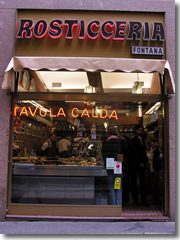
A rosticceria and tavola calda in MilanRosticceria: A tavola calda (see below) with some spitted chickens roasting in the window. - Pizzeria: A casual restaurants where you go to eat pizza. Again, pretty obvious, but here are a few Italian quirks. Traditional pizzerie are open only in the evenings, and they don't serve much beyond pizza. That said, many trattorie have slapped a pizza oven in the kitchen (largely to service the tourist trade, which expects pizza to be available everywhere), offering a wider variety of dining options—and many are open at lunch as well, which is why you'll see some restaurants proudly advertising "pizza anche à pranzo!" (pizza even at lunch!"). Oh, one more thing: all Italian pizzas are pizzas for one, You don't order a pizza to split, or to share with the table. Each person orders his or her own pizza, and while they are pretty large, they usually have ultra-thin crusts so it's not too hard to wolf an entire one down.
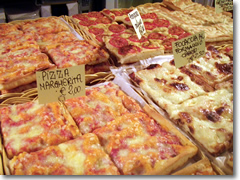
Pizza by the slice in Italy.Pizza à taglio: Sometimes called pizza rustica (especially in Rome), this is a pizza-by-the-slice joint, tiny shops where they cut the pizza of your choice from big, steaming sheets and wrap it halfway up in waxed paper for easy carrying. Just point to the bubbling sheet with your preferred toppings behind the counter and hand over a couple euro. It's priced by weight, but they'll slice off however much what you hand them will cover. About €2 will get you a healthy portion. Some varieties to try: pizza margherita (tomato sauce, cheese, and basil), pizza con patate (with julienned potatoes, but no sauce), and pizza napolitana (with anchovies). Or go minimalist with pizza rossa (just the sauce) or pizza bianca (just the dough, brushed with olive oil and salt, sometimes with rosemary; exquisite). - Tavola calda: A very informal (and sometimes self-serve) eatery where you usually choose from a pre-prepared selection of hot dishes—like an olde worlde cafeteria. Great for a quick, light meal.
- Brek: This chain of high-class cafeterias—where they cook each dish for you on the spot at prices that range mostly from $1 to $3—has spread to 21 cities across the country, including Rome, Milan, Turin, Venice, Padova, and other popular tourist destinations. Find them at www.brek.com.
- Trattoria: Usually a traditional, family-run establishment that serves fresh pasta and other home-cooked food.
Some other Italian food terms it's good to know
- Pane e coperto: Nearly all Italian restaurants have an unavoidable pane e coperto ("bread and cover" charge) of anything from €1 to €15—though most often €2 to €5—per person that is automatically added on to your bill. This is perfectly normal, and perfectly legal (though a few, trendy restaurants make a big deal about not charging it).
- Servizio incluso: Always glance at the bottom of the menu (including front and back covers) to see if there is a line about "servizio incluso." This means the service charge is included and you do not need to leave a tip (though for exceptional service in a fine restaurant, it is customary to leave an extra euro or so per person). If nothing of the sort is printed on the menu—or you are simply unsure—just ask: "É incluso il servizio?" (eh een-CLOO-soh eel sair-VEET-zeeo?) to find out where service is included. If not, leave about 10% (no, not 15% or 18% or whatever the crazy inflationary amount it's supposed to be now in the States because we don't actually pay our waiters and kitchen staff proper wages; In Italy; 10% is still traditional).
- Menu à prezzo fisso: A fixed-price meal of several courses (usually appetizer, entree, and dessert, plus wine and/or coffee) offered from a restaurant's menu; almost always an outstanding dining value. Sometimes this is called a menu turistico, usually implying a smaller selection and one of more basic dishes. More details are on the fixed-price menu page. » more
- Menu degustazione: A "tasting menu" is sort of the opposite of a menu à prezzo fisso—exact same idea (a set-priced meal of several courses), however one designed to show off the chef's greatest creations—and usually not too cheap. Ranging anywhere from €25 up to €150—though usually in the €40–€80 range—a menu degustazione may feature the kitchen's most creative dishes, or perhaps its best efforts at traditional cuisine (sometimes this is called the "menu tradizionale"). Some restaurants offer multiple variations as different menus, each with fanciful names. Some of my favorites are the ones offering not just dishes, but sampler platters of two or three of the kitchen's top dishes at each course. There are many permutations and, while not cheap, tasting menus often actually cost less than ordering a full meal la carte, and therefore offer an excellent deal if you're looking to splash out in fine dining.
Tips & links
Useful links & resources
- Car resources
- Emergency service/tow: tel. 803-116
- Highway agency: Autostrade.it (traffic info, serivce areas, toll calculator, weather)
- Italian automotive club (~AAA): Aci.it
- ZTLs: Ztl-italia.blogspot.com (lightly outdated, but handy, links to cities' traffic-free zones)
Share this page

Search ReidsItaly.com