- Places
- Plans
- Itineraries
- Experiences
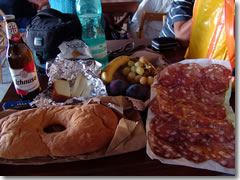
A picnic I had on Isola Asinara in Sardegna (you can tell it was Sardegna form the weird holed bread and the bottle of Ichnusa beer).A bottle of Chianti, a crusty loaf of bread, some fresh fruit, local cheeses and salamis, yogurt, and a pastry to top it all off makes a fabulous meal.
Stop at a half-dozen little neighborhood shops, and $6 to $10 per person later you'll have a feast fit for a king.
Far from being a budget fall-back, picnicking in Italy can be as much fun and unforgettable as a meal in the finest restaurant.What with all the restaurants I eat in just to do my job, one of my most memorable Italian meals ever remains a late-night picnic in a hotel room in Tuscany with my parents and a buddy.
Visit a few small neighborhood grocery stores or an open-air market and point to anything that looks like a local specialty. 100 grams is usually the perfect amount or one person.
I have broken bread (focaccia, actually) with my Boy Scout troop on a patch of grass overlooking the Colosseum in Rome, enjoyed the world's freshest mozzarella direct from the farm in the fields of southern Campania, dined gloriously alone on a panino and some clementines atop a wall overlooking the vineyards of Tuscany, had members of a Italian hiking group compete to share the best of their brown-bagged bounty with me on a Sicilian hilltop near some Byzantine ruins (after which we picked almonds off a tree and cracked them open with stones), and sat with a friend on the grassy banks above the Brenta Canal—the villa-peppered country escape of Renaissance doges just outside of Venice—and watched the boats glide by as we munched sandwiches, shared a bottle of fizzy Lambrusco wine, and ate an entire watermelon...
When it comes time to put together that picnic to enjoy sitting around the fountain of a piazza, on your day trip, or just back in the hotel room, you can visit a string of little Italian food shops:
The panificio or forno can provide breads and pastries, a fruttivendolo is for fresh fruit and veggies. A latteria sells cheeses, vini olii or enoteca carry bottles of wine, and an alimentari (little grocery store) is good for packaged goods, salamis, drinks, and a bit of everything else. (You'll sometimes find supermercati—supermarkets—in the basements of large department stores.)
You can order by the kilo (2.2 pounds) or mezzo kilo (half a kilo), but most people order in their foods in grammi (grams).
One hundred grams is nicknamed un etto, which is slightly less than a quarter pound. When you're throwing together a picnic for 2–4 people, usually one etto each of two cheeses, another etto of prosciutto, and an etto of olives (or whatever)—added to a loaf of bread, bottle of vino, and some fruit—somehow ends up being just the right amount. (Often if you just say picnic per due—"picnic for two people"—the workers will give you the appropriate portions.)By noon many stall owners are starting to pack up, the bread bins are full of only crumbs, the best bell peppers are gone, and the lettuce is wilting. By 1pm most markets are deserted save for a few cats pawing through the leftovers.
Please, whatever you do, try not to fall back on American fast-food chains if you're in a hungry pinch. The local specialties that make up the "fast food" categories of Italy are almost invariably better—and much cheaper—than una Big Mac.
If you still crave a cooked meal, but don't want to pay for a full restaurant spread, each country has its own downscale version of snacking on delicacies or dining on prepared foods for not much more than the cost of the ingredients.
Go to a tavola calda, where they sell prepared hot food by weight, for steaming plates of spicy penne and herbed potato wedges. A rosticceria is a tavola calda with some spitted chickens roasting in the window. A pizza à taglio, sometimes called pizza rustica (especially in Rome), is a pizza-by-the-slice joint.
A fiaschetteria—named for the fiashe, or straw-bottomed flasks, in which wine was once delivered from the vineyards—is a modest little wine shop-with-a-bar selling sandwiches and/or simple dishes along with the vino. An any Italian bar or caffé also sells sandwiches and such—sometimes excellent, other times just passable, but with the benefit that Italian bars open early and close very late, so you can grab a bite at any time of day or night.
Share this page
Search ReidsItaly.com



This article was written by Reid Bramblett and was last updated in April 2015.
All information was accurate at the time.
about | contact | faq
» THE REIDSITALY.COM DIFFERENCE «
åß
Copyright © 2008–2017 by Reid Bramblett. Author: Reid Bramblett


