- Places
- Plans
- Itineraries
- Experiences
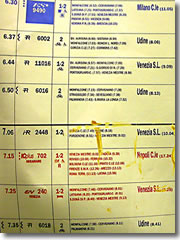 A close-up of the "departures" poster in the Trieste train station. The left column shows departure times, the next one the type of line (R for regional, iR for inter-regional, IC for InterCity, EN for EuroNight, and ES for EuroStar) and the train number and (in the case of some of the high-speed lines) its name. The third column tells you which trains are composed of both first- and second-class cars and which (those local runs to Udine) of just second-class as well as whether you can bring bikes or wheelchairs on board, if sleeper cars are available (as is the case with the 7:25 to Venice), and—most importantly—an 'R" to indicate on which trains a reservation is required (here, on the 6:20 to Milano, and the 7:15 to Napoli/Naples). The biggest column runs down the list of all intermediate stations where the train will stop followed by, in large type, the final destination and arrival time. (In order to make it legible on the screen, I cut off the two right-most columns, which showed some esoteric details on each train, and, on the far right in a big bold font, the number of the track from which it will leave.) So, this schedule shows that you could catch one of three different trains to Venice. The "regional" that leaves at 6:44 gets you into Venice at 9:09, for a total trip time of 2:25. The 7:06 "inter-regional" takes nearly three hours to get there—but it'd be far quicker to wait until 7:25 and hop the speedy EuroNight, which actually gets to Venice first, arriving at 9:25 for a trip time of just 2 hours.
Some trains still have the old-fashioned couchette configuration: Each car has a corridor along one side, lined with windows on the outside and doors on the other. These doors open onto 10 little couchettes, or compartments, each of which seats six to eight people (or, in first-class compartments, four to six people in slightly cushier chairs—but that's not worth the added expense).
Sadly, most short-run trains and new highs-speed long-haulers are increasingly switching over to the modern straight-through cars with seats running down both sides of an open aisle. These always make me feel more like I'm at home commuting to work than traveling in Europe on a grand tour, but hey, that's progress for you.
For train schedules and ticket prices in Europe, see the websitess of ItaliaRail.com or Rail Europe or the that of the Italian rail system, Trenitalia.com.
Though note that, aggravatingly, the Trenialita site now defaults to searching only for its high-speed—and higher priced—"Le Frecce" trains. The booking widget on the main page has a choice of tabs above it: "Le Frecce" or "Tutti i Treni." You want that second one. (If you forgot, make sure that, on the results page, you look at the choices along the top bar above the results for "Search On" at the end and, if it says "Le Frecce" click on it to select "Tutti i Treni" instead.)
Italy has a rainbow of train classifications ranging from local runs that stop at every tiny station (confusingly named Diretto, which means "direct") to high-speed bullet trains such as the ETR/Pendolino.
These trains include specialized and expensive high-speed trains within nations (such as Italy's ETR/Pendolino), as well as international high-speed runs with fanciful names, like the Artesia between France and Italy (connecting Rome-Paris, Milan-Dijon, and Florence-Chambray), or the chic Talgo Night - Train Hotel Elipsos
connecting Milan with Barcelona, Madrid, Paris, and Zurich.
Beyond these, the fastest trains you'll usually take are EC (Eurocity) or IC (Intercity). The only difference between the two is that the Eurocity train crosses an international border (overnight versions are sometimes called EN, or EuroNight).
There are actually several private lines rail in Italy, mostly filling in gaps where the state-run FS does not have service (notably for tourists, in Umbria), but normally you barely notice this. You just go to the train station and buy a ticket, rarely realizing that the train is being run by a separate company.
However, now there is reason to take note. As of 2012 there is a private high-speed line called Italo Treno (www.italotreno.it). Its train cars are painted Ferrari red, and it's aiming to compete directly with FS on the main trunk lines connecting Italy's major cities.
The main line connects Salerno and Naples with Rome, Florence, Bologna, Milan, and Turin.
They is also a branch service from Bologna up to Padova and Venice, and down from Bologna to Rimini, Pesaro, and Ancona on the Adtriatic coast.
Italo Treno is about as fast as most of the high-speed FS trains (though a half-hour slower than the fastest Frecciarossa trian from Rome to Milan), but it does differ importantly in four ways:
Many high-speed trains throughout Europe require that you reserve a ticket in advance for a supplemental fee. Any train marked with an "R" on a schedule needs to be reserved ahead of time for a fee ranging from $10 up beyond $50 (the latter when a meal is included).
If you're buying point-to-point tickets, this supplement is included in the full price. With a railpass such as Eurail, you will have to purchase this supplement separately. The train conductor will sell you one, but he also will assess you a small penalty fee. I always check at the ticket office to be sure and pay for it in advance.
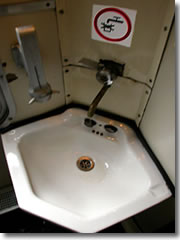 Aside from a few public fountains, trains are really the only places in Europe where the old "don't drink the water" rule applies. Take it from me, though: you will get thirsty, so plan ahead and bring a bottle of water on board with you (or, on most trains, there is a bar car).
You'll also need to reserve any sleeping couchette or sleeping berth before boarding a train.
You can almost always reserve a seat within a few hours of the train's departure, but I play it safe by booking a few days in advance.
If I'm only going to be in town for a day or two, I go ahead and book my ongoing ticket as soon as I arrive. If I'm lucky enough to be sticking around longer, I just plan that, as part of my penultimate day in town, I will pay a a visit to the train station to book tickets. (For more on all this, see the Tickets & Reservations section.)
One final note: Don't drink the water on trains, not even to rinse your mouth. It's greywater meant for hand washing only. This is a bit frustrating, since trains—especially overnight trains—dehydrate you quickly.
So make sure you bring bottled water to sip throughout the ride and also to rinse out your mouth (and your toothbrush) after an overnight train ride.
Here's a handy dandy chart to give you a sense of how long your train connections will be connecting major Italian cities and vacation destinations ("Amalfi Coast" means Sorrento, where the trains end and the coastal bus begins). Note that this is the quickest you can expect to make the journey, using the fastest trains and the closest connections should you have to change trains.
 |
 |
 |
 |
 |
 |
 |
 |
 |
 |
 |
 |
|
| Amalfi Coast | — |
4:43 |
6:09 |
7:34 |
4:36 |
8:33 |
6:55 |
1:06 |
10:06 |
2:41 |
8:31 |
7:31 |
| Assisi | 4:43 |
— |
8:21 |
5:50 |
2:27 |
6:54 |
5:10 |
3:23 |
14:28 |
1:41 |
6:26 |
5:20 |
| Brindisi | 6:09 |
8:21 |
— |
11:00 |
7:06 |
10:38 |
8:27 |
4:49 |
13:09 |
4:55 |
10:23 |
9:14 |
| Cinque Terre | 7:34 |
5:50 |
11:00 |
— |
2:37 |
1:15 |
3:28 |
6:14 |
17:09 |
3:23 |
3:20 |
5:40 |
| Florence | 4:36 |
2:27 |
7:06 |
2:37 |
— |
3:41 |
2:10 |
3:16 |
12:39 |
1:37 |
3:46 |
2:40 |
| Genova | 8:33 |
6:54 |
10:38 |
1:15 |
3:41 |
— |
1:32 |
7:13 |
17:54 |
3:59 |
1:43 |
4:10 |
| Milan | 6:55 |
5:10 |
8:27 |
3:28 |
2:10 |
1:32 |
— |
5:35 |
16:20 |
3:59 |
1.40 |
2:23 |
| Naples | 1:06 |
3:23 |
4:49 |
6:14 |
3:16 |
7:13 |
5:35 |
— |
8:46 |
1:21 |
7:11 |
6:11 |
| Palermo | 10:06 |
14:28 |
13:09 |
17:09 |
12:39 |
17:54 |
16:20 |
8:46 |
— |
10:44 |
20:15 |
15:52 |
| Rome | 2:41 |
1:41 |
4:55 |
3:23 |
1:37 |
3:59 |
3:59 |
1:21 |
10:44 |
— |
5:40 |
4:16 |
| Turin | 8:31 |
6:26 |
10:23 |
3:20 |
3:46 |
1:43 |
1:40 |
7:11 |
20:15 |
5:40 |
— |
4:15 |
| Venice | 7:31 |
5:20 |
9:14 |
5:40 |
2:40 |
4:10 |
2:23 |
6:11 |
15:52 |
4:16 |
4:15 |
— |
www.italiarail.com
www.raileurope.com
www.trenitalia.com
www.italotreno.it (private high-speed line)
Share this page
Search ReidsItaly.com



This article was written by Reid Bramblett and was last updated in April 2015.
All information was accurate at the time.
about | contact | faq
» THE REIDSITALY.COM DIFFERENCE «
åß
Copyright © 2008–2017 by Reid Bramblett. Author: Reid Bramblett


