- Places
- Plans
- Itineraries
- Experiences
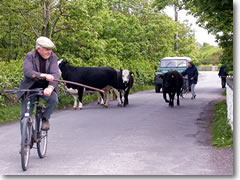
Most Italian drivers are much more aggressive than American ones. Be prepared, and leave the road rage at home.
Italian road rules are similar enough to American ones that you'll get by fine. There are, however, some important differences.
Assume the other drivers have a better idea of what they're doing than you do, and take your hints from them. » more
In Italy, the left lane—or fast lane—truly is only for passing. The only people who cruise in it are folks in Mercedes, BMWs, or Ferraris who are flying along at well over 100 mph and will squash you like a bug if they come across you in their lane.
Similarly, on a two-lane road, if someone comes
up from behind and flashes their lights at you, it's a signal for you
to slow down and drive more on the shoulder
so that
they can pass you more easily (two-lane roads here routinely become
three cars wide).


The number in a red circle
is
the speed limit. The number
with a gray slash through it
indicates where the speed limit
zone ends—and a new one
will begin. » More road signs.I know: obvious one, right? Problem is, there's this persistent myth that there are no speed limits in Europe. This is untrue. (Well, except for certain stretches of the German Autobahn.)
Italian roads do, indeed, have speed limits. And yes, these limits are (now) enforced.
Except when posted otherwise, the following speed limits apply:
Until recently, these limits are widely ignored and rarely enforced—not that this knowledge helped if a cop did decide to issue you a ticket, or you were stopped by a carabiniere (that's a member of the national police force, which is a branch of the military and hence carries automatic weapons and hence should be obeyed immediately and at all times).
However, notice I wrote "until recently" speed limits were rarely enforced. Thanks to speed trap cameras, this is no longer the case. Just in the past few years, Italians have gotten way more aggressive about issuing tickets—for speeding, parking, and even not wearing a seatbelt (which, by law, you must do). Italy's reputation as a nation of scofflaws may actually be starting to change.
The fact that an automatic camera can sense a speeder, snap a photograph of your license plate, send a message to a computer with the data, then automatically issue you a ticket—even if, while this is happening, every cop in town is just sitting around the station eating the proverbial doughnut—means if you speed, expect to get a fine in the mail.
No, you can't just ignore a ticket. Thanks to the wonders of modern technology, any unpaid tickets will eventually find their way to you via the car rental agency, which will merely provide the local municipality with your address, then automatically charge your credit card a whopper of a fee for their troubles (on the order of $80–$90). Several months later, you will get the fine in the mail—a fine you can only pay by international bank wire transfer, for which your bank may charge anywhere from $15 to $70.
I am totally serious about this. In 2010, I had to pay more than $300 in fines and fees for unwittingly going a whopping 6 mph over the speed limit on an empty secondary road in the interior hinterlands of Sardegna 11 months earlier.
Be especially careful about parking tickets. Italian cops have gotten brutal about ticketing (and even towing) illegally parked cars.
Many Italian cities—most notably Florence and Rome but also smaller cities like Siena, Siracusa, and Assisi—are either experimenting with or have already adopted the ZTL ("Zona Traffico Limitato" or Zone of Limited Traffic)—you may have heard of something similar called a "congestion charge" famously instituted by London (and famously shot down in New York). Milan now has one, too: €5 per day.
A ZTL usually entails closing off the historic center to all cars that do not have a pass (mostly residents and commercial trucks).
The tricky bit is you can still drive into them—enforecment is by traffic cam, not physical barriers—you're just not supposed to, so you have to know they're in place and how to avoid accidentally entering the ZTL.
Practical upshot: Traffic cameras will take a picture of your license plate if you enter the ZTL. If you are not a resident who has paid for a registered pass—or do not get your hotel to register your car with the police immediately upon arrival so they know you are a tourist and can issue a temproary pass—you will be hit with a huge fine.
Since this fine has to find you via the car rental company, that company will tack on a frankly obscene "convenience fee" (often of $60 or so). What's more, the delay going via the rental company often results in the notice arriving to you after its due date, so you will also incur an additional late fee from the city.
Yes, I speak for experience here.
Best solution: Know when a city has a ZTL and respect it. Park the car at one of the public lots ringing the ZTL that were set up for this very purpose (and which are far, far cheaper than private garages in town) and enjoy the city on foot. It's more fun that way, anyway.
(Not to bore you with details, but local backlash has led a few citites that had previously implemented a ZTL—including Milan and Palermo—to suspend them, at least for now. In other words, this is a constantly changing new reality for traveling in Italy.
Check with the local tourist office before driving into town to get the latest. There's also a blog—in Italian—that tries to keep track of ZTLs all across Italy: ztl-italia.blogspot.com). It has gone a little moribund in the past few years, but many of the maps and links are still accurate.
Everything's measured in kilometers here (mileage and speed limits).
For
a rough conversion, one kilometer equals a weensy bit more than 0.6
miles—so just divide the amount in half and add back ten percent (in other words 120km in miles would be half—60 miles—plus ten percent of 120—or 12 miles—for a total of 72 miles).
» more
That gas may look reasonably priced, but remember the price is per liter, not per gallon. Gas in Italy is preposterously pricey, costing—as of Fall, 2013—an average of $9 per gallon—no foolin'. Budget accordingly when deciding between taking a train or renting a car.
The AA (www.theaa.com)—the British version of AAA, not the group that helps alcoholics—provides an updated monthly gas chart, downloadable in Word format, showing you how much gas costs per liter (er, "litre") in countries across Europe. Remember to multiply that by 3.8 to get gallons (or just guesstimate by multiplying by four) and then by the current exchange rate to get a sense of the going rate per gallon in dollars—and a sense of just how insanely expensive gas is in Europe. Maybe now you understand why Europeans think we're crazy to complain about the price of gas in the U.S. (and why they are partial to such tiny, fuel efficient cars) » more
Most major autostrade (highways) in Italy are tolls roads. The fee for riding a toll road is €0.06672 per km, which works out to about 14.6¢ per mile.
To put that in perspective, here are some actual toll rates for typical autostrade trips in Italy (prices as of 2013):
You can find out the current rates, rules, and calculate tolls at www.autostrade.it.
| Italy maps | |||
 Michelin Italy Map |
 Rick Steves' Italy Planning Map |
 Michelin Italy Tourist & Motoring Atlas |
 Rough Guide Italy Map |
Save some of the headaches and trouble of finding your way by knowing where you're going in the first place. Simple, no?
Also, directional road signs in Italy are funny. Sometimes they do mention route numbers, but very rarely (or at least, not with the regularity one is used to driving in the U.S. or Canada).
Knowing the route you want is useful, but not nearly so useful as knowing what towns are on that route. This is because road signs at a turnings will point toward towns that lie in each direction.
Here's the tricky part. You never know which towns it will mention. Sometimes it will be just one town, or a group of two to three that all lie in that direction, or sometimes a whole list of a half-dozen.
More confusingly, you never know whether the town(s) listed will be: (a) the next blip of a hamlet the road passes through, (b) the next major town down that road, (c) the provincial capital down the line a ways, (d) the name of the town (could be big, could be tiny) that sits at the next intersection of another major (or maybe minor) road, (e) the regional capital 100 miles down the pike, (f) some other major city 250 miles away, or (g) Rome.
This is where the map comes in. Take a good look at the next road you need, and memorize the names of all those towns lying along it that might potentially be on the signs (the next dot or two on the map, the first big dot down the road a ways, the really big dot at the end of the road, etc.)
[In a further wrinkle, sometimes the next big town down the road will not appear on the signs at all, and this is out of spite. I kid you not. If two neighboring towns or cities are historical rivals, with several hundreds years of mutual enmity seething between them, they will sometimes refuse to acknowledge each other's existence on road signs. For example, it was only recently that Lucca and Pisa—which are only 16 miles apart—started posting road signs on how to get from one to the other. Of course, the municipalities can only ignore one another on signs under their direct control (usually local and provincial roads). This doesn't stop locals from blacking out their rival's name when it appears on signs for regional or state roads. Welcome to Italy!]
Never leave anything visible in the car when you park it. When you check into a hotel, take all of your luggage in with you, even if you won't need it. This advice goes doubly in Naples.
Bring your driver's license, of course, but if you do plan to drive in Italy, you should also bring an International Driver's Permit in addition to your regular driver's license. This document—which pretty much just translates the data on your home license into several languages—costs $10 from any AAA office (you don't have to be a member).
Speaking of AAA (www.aaa.com), not only do its offices provide one-stop shopping for International Drivers Permits and traveler's checks, they also have some free maps and travel info on every country in the world. These materials are really not that great for Italy (or anywhere in Europe), but they are decent for an overview.
You can call the ACI (Automobile Club d'Italia, sort of like America's AAA or Britain's AA; www.aci.it) at tel. 06-491-716 for information (in English) on: "road and weather conditions, highway tolls, ferries, tourist itineraries, mileage distances, customs formalities, currency, and automotive procedures."
| car | automobile (ow-toh-MO-bee-lay) or macchina (MAH-keen-ah) |
| gas | benzina (ben-ZEE-nah) |
| diesel | gasolio (gah-ZOH-lee-oh) / diesel (DEE-zell) |
| Fill it up, please | al pieno, per favore (ahl pee-YAY-noh, pair fa-VOHR-ray) |
| Where is... | Dov'é (doh-VAY) |
| ...the highway | l'autostrada (lout-oh-STRA-dah) |
| ...the road for Rome | la strada per Roma (lah STRA-dah pair RO-mah) |
| to the right | à destra (ah DEH-strah) |
| to the left | à sinistra (ah see-NEEST-trah) |
| straight ahead | diritto (dee-REE-toh) / avanti (ah-VAHN-tee) |
| keep going straight | sempre diritto (SEM-pray dee-REE-toh) |
| thank you | grazie (GRAT-tzee-yay) |
| please | per favore (pair fa-VOHR-ray) |
| yes | si (see) |
| no | no |
| Do you speak English? | Parla Inglese? (PAR-la een-GLAY-zay) |
| I don't understand | Non capisco (non ka-PEESK-koh) |
| How much is it? | Quanto costa? (KWAN-toh COST-ah) |
Share this page
Search ReidsItaly.com



This article was written by Reid Bramblett and was last updated in April 2015.
All information was accurate at the time.
about | contact | faq
» THE REIDSITALY.COM DIFFERENCE «
åß
Copyright © 2008–2017 by Reid Bramblett. Author: Reid Bramblett


